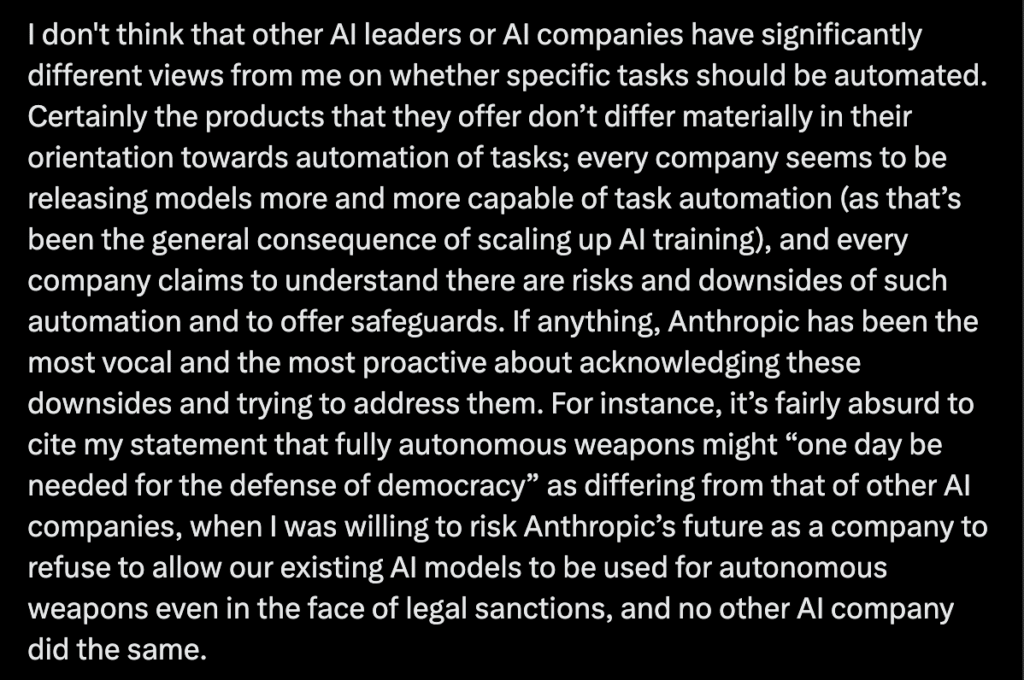
Anthropic CEO Dario Amodei rejected the idea that he wants people to surrender their free will to AI. In a November 25, 2026, post on X, he argued that giving a system responsibility for a specific task—even an entire software project—is different from giving it authority to decide how society operates. A system might make faster or safer decisions, he said, without having the democratic legitimacy to make them on people’s behalf.
Amodei was responding to an Axios report about concerns among employees at Anthropic and OpenAI over whether increasingly capable models could be safely released or more powerful ones safely trained. OpenAI CEO Sam Altman and Meta chief AI officer Alexandr Wang had both publicly opposed handing control of society to superintelligence. Neither named Anthropic; it was Axios that interpreted their remarks as a contrast with Amodei’s position.

That interpretation drew on examples Amodei had discussed. In November 2024, he suggested that an AI might one day lead a research project, directing people or other AI systems. In an interview released in February 2026, he said it might be preferable to delegate a task involving human safety if AI could perform it more reliably. In his response, he pointed to another theme in his writing: democratic institutions should constrain AI, including the power of the labs that build it.
Where Amodei would limit automation
Amodei put end-to-end software development in the same category as driving a car or designing a cancer drug: each is a particular job that people might choose to delegate. He identified four circumstances in which greater autonomy would not necessarily be desirable:

- Developing the next generation of AI. Amodei cited Anthropic’s position, published in early November 2026, that it did not consider it safe for Claude to build successive generations of frontier models on its own without meaningful human oversight and an understanding of the development process.
- Displacing workers. Where full automation could cause severe job losses, he said slowing or pausing a deployment could give workers time to adapt.
- Researching AI safety. AI can help investigate whether a system behaves as intended, but researchers cannot take its findings on trust—especially when they are relying on a system they do not fully understand to evaluate its own safety.
- Preserving human choice. Even if AI performs a task better, Amodei said, people may still want to do it themselves. Who decides whether to automate should depend on the task, rather than on a blanket decision by any one company or government.
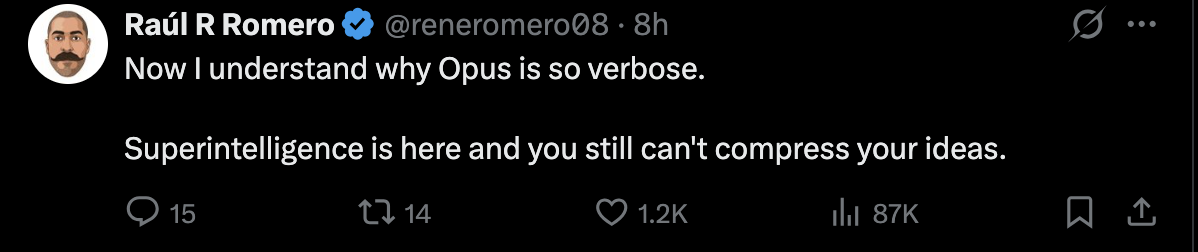
Amodei also challenged rival executives to explain what their emphasis on human control meant for their products. Frontier AI companies were all releasing models capable of doing more work autonomously, he argued. Without a corresponding difference in product design, he called the competing messages “vibes-based commercial and political positioning.” Some social media users responded by criticizing the length of his post; Raúl R Romero joked that it explained why Claude Opus was so verbose.
Who holds voting power at Anthropic
The debate came less than a week after Anthropic’s November 19 Nasdaq debut. Its shares opened at $111.50 against an $83 offering price. Reuters reported that they fell as low as $76.60 on November 24, down 12.6% that day. They traded near $80.50 during the November 25 session.
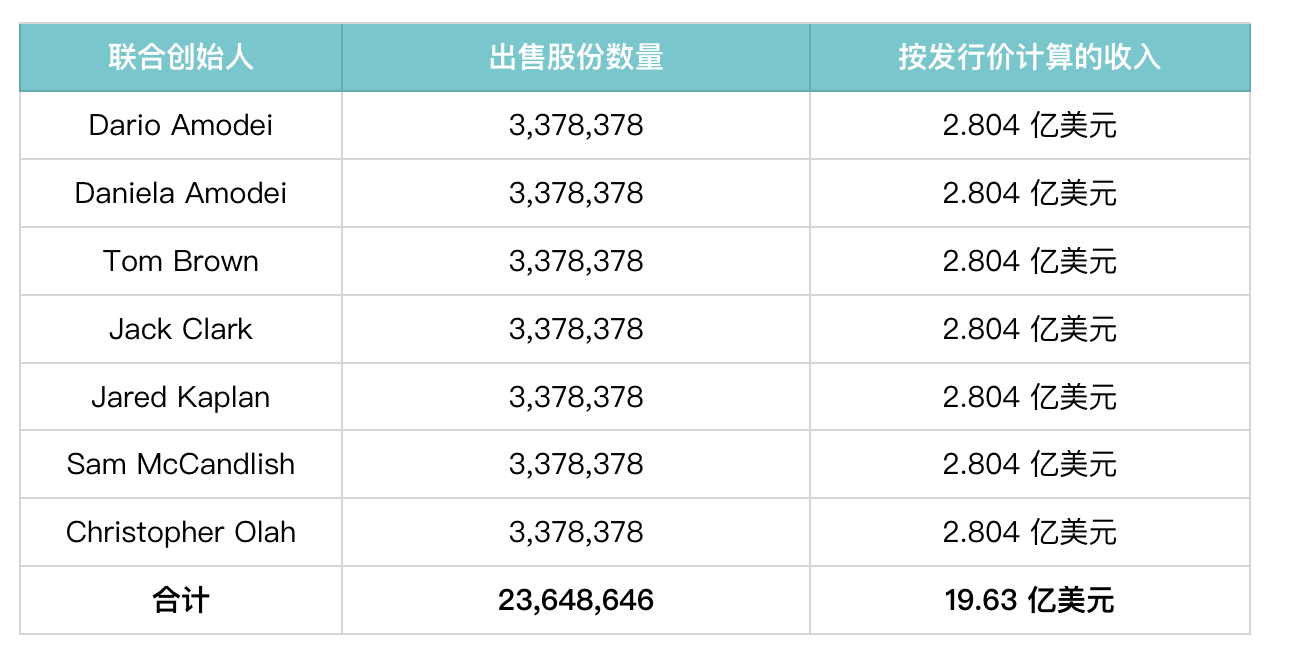
The founders’ share sales preceded that decline. SEC Form 4 filings submitted November 23 showed that Amodei and his sister, Anthropic president Daniela Amodei, each sold 3,378,378 Class A shares on November 20 at $83 per share, receiving about $280.4 million apiece before taxes.
According to the prospectus and TechCrunch’s reporting, all seven co-founders sold the same number of shares under arrangements disclosed before the IPO. Each sold about 1.4% of their pre-IPO holdings. The sales did not end their collective voting control: the prospectus said Class F shares held by their Founder LLC carried about 50.1% of Anthropic’s voting power.