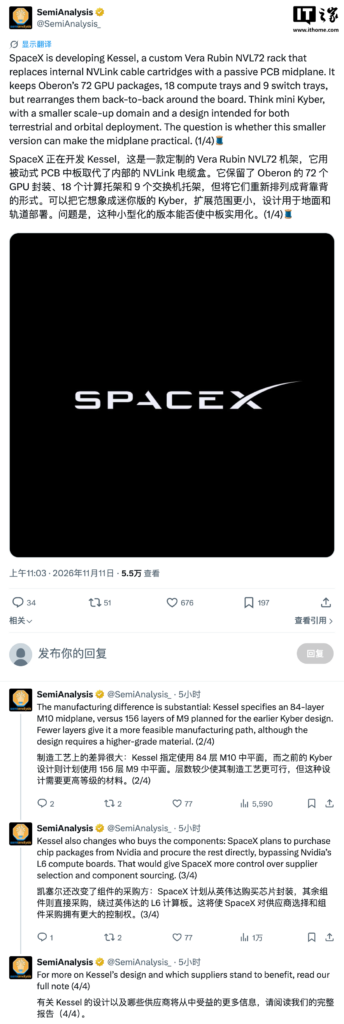
In a November 11, 2026 post, semiconductor research firm SemiAnalysis said SpaceX was developing Kessel, a custom AI server rack intended for ground-based data centers and computing in orbit. The design would retain Nvidia chips while giving SpaceX more control over the hardware around them. The account describes a plan, not a deployed system.
According to SemiAnalysis, SpaceX plans to buy chip packages directly from Nvidia and source other components itself, rather than use Nvidia’s L6 compute boards. Kessel would also replace the internal copper-cable modules used to connect computing equipment and switches in Nvidia’s standard Vera Rubin NVL72 rack with a passive circuit-board midplane at the center of the rack.
The proposed rack retains the Oberon design’s 72 GPU packages, 18 compute trays and nine switch trays, with trays mounted back-to-back on either side of the midplane. SemiAnalysis likened it to a smaller version of Nvidia’s Kyber design, which the firm described in March 2026 as having 144 GPUs.
SemiAnalysis said Kessel’s proposed midplane uses higher-grade M10 material and has 84 circuit-board layers, compared with M9 material and 156 layers planned for Kyber. Fewer layers could ease manufacturing, the firm said, but whether the smaller midplane design can work in practice remains uncertain.
In a separate report the previous week, SemiAnalysis said SpaceX had raised its 2027 computing-capacity target to about 13 GW, with projects totaling 3.6 GW under construction across multiple sites. The firm pointed to expansion around Colossus and a planned data center at part of the Starbase rocket complex, while warning that available power supply was insufficient for the data centers it described.