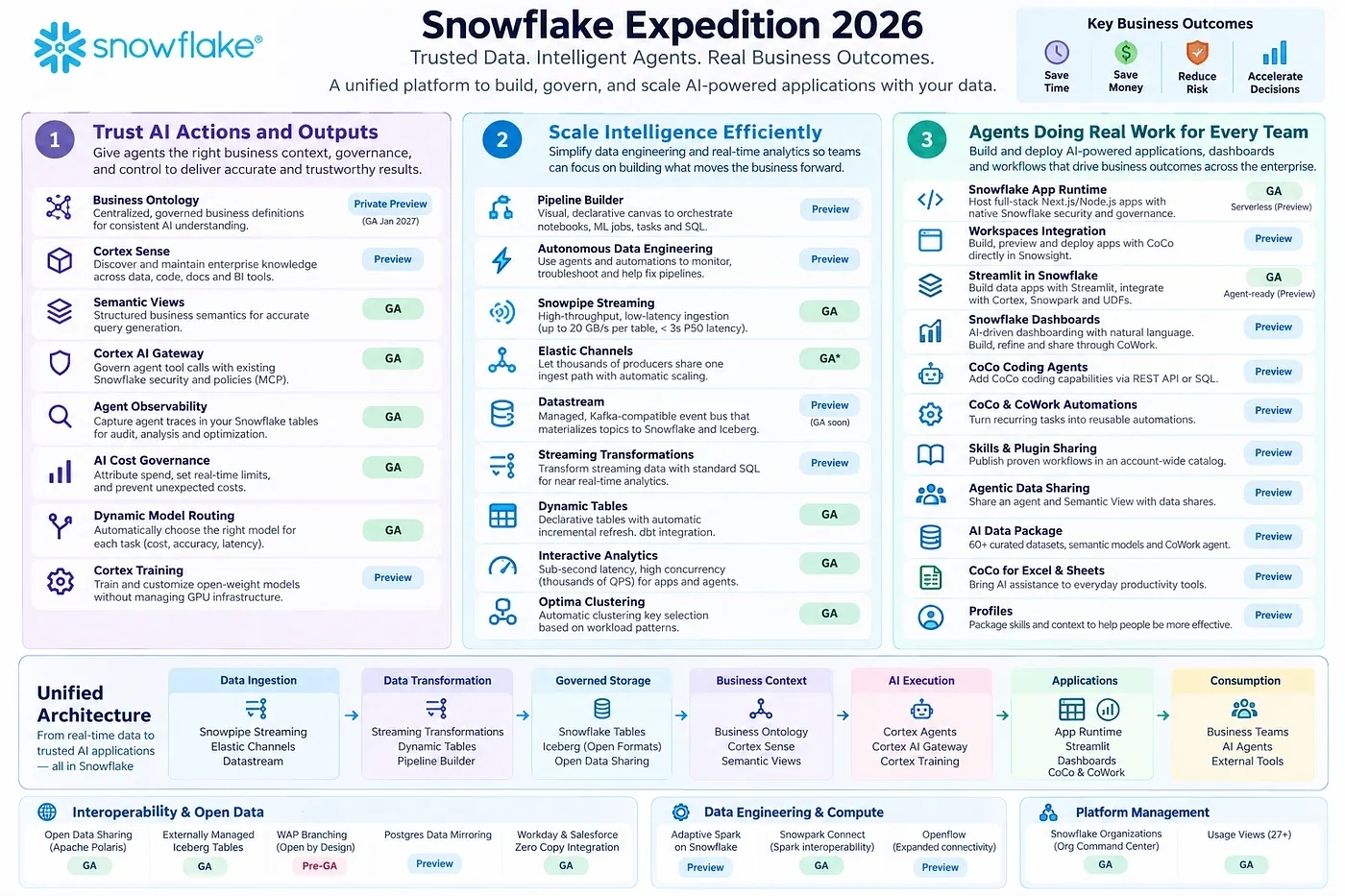
In a report published on November 20, 2026, Snowflake outlined updates presented at its 2026 Expedition event. The announcements span business definitions for AI agents, streaming data, dashboards, application hosting and interoperability with Apache Iceberg. The central idea is to give AI systems access to governed business context while keeping more data and application workflows on the Snowflake platform.
Business context and controls for AI agents
Snowflake’s Business Ontology is intended to let organizations manage approved definitions of concepts such as “customer” and “revenue,” including relationships between definitions used by different departments. It is designed to work alongside Semantic Views, not replace them. Cortex Sense, meanwhile, is intended to discover existing context in code, metadata, documents, BI tools and usage signals.
For agents that can call tools, Cortex AI Gateway is designed to check Model Context Protocol (MCP) calls against Snowflake’s role-based access controls. Snowflake also described spending limits, execution traces stored in governed SQL tables and dynamic model routing, for which it claimed up to a threefold improvement in token efficiency. Other announcements included Cortex Training for model customization, reusable CoCo workflow skills and an AI Data Package with more than 60 industry datasets and preconfigured CoWork agents.
Streaming and interactive queries
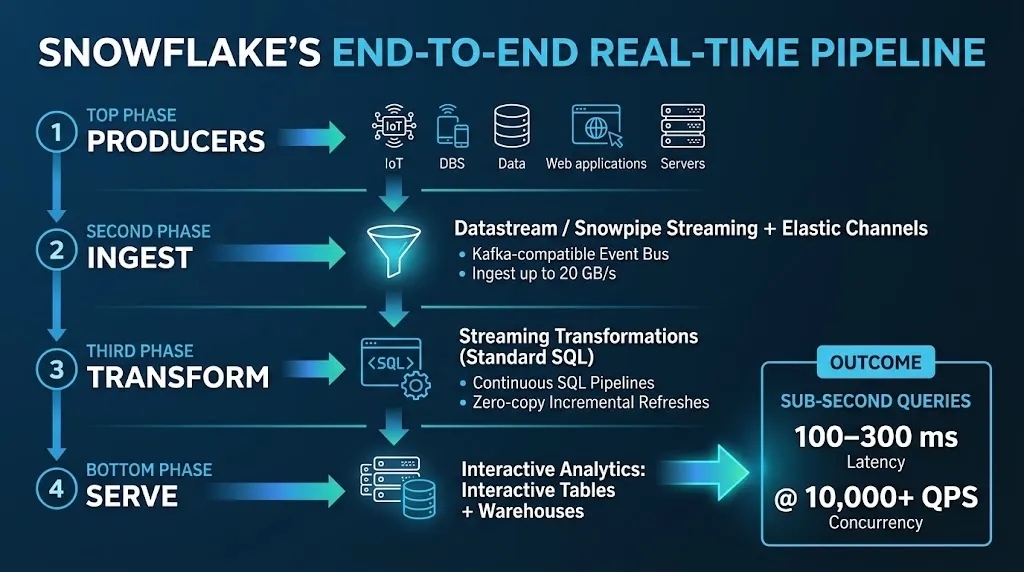
Snowflake described an architecture intended to bring the time from a raw event to an interactive application query below 15 seconds, without a separate query-serving database. It includes Datastream, a managed Kafka-compatible event bus, and Snowpipe Streaming, which Snowflake said can ingest up to 20 GB/s per table. Elastic Channels are intended to support thousands of concurrent producers, while developers can define in-flight transformations using SQL.
For Interactive Tables and Interactive Warehouses, Snowflake claimed query latency of 100–300 milliseconds at more than 10,000 queries per second. It also said compute-credit consumption could be up to 40% lower than on its first-generation hardware. These are reported product claims, not independent performance results.
Dashboards, applications and Postgres
Snowflake Dashboards lets users generate charts through natural-language questions and pin them to dashboards. Rather than charging per user seat, Snowflake said the product runs on consumption of its warehouse resources; it also described tools for migrating existing BI assets.
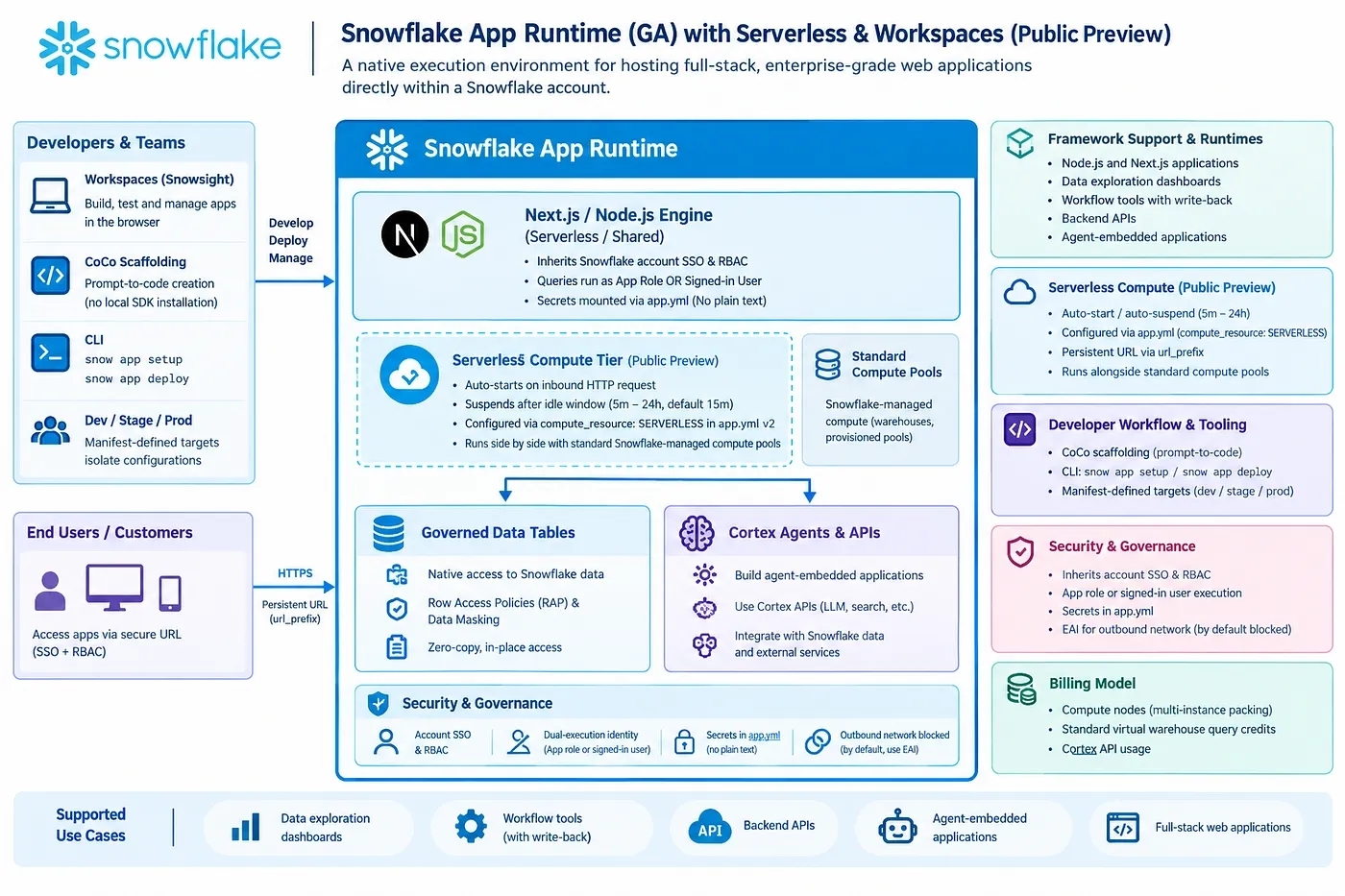
Snowflake App Runtime adds hosting for Node.js and Next.js applications within Snowflake. Its serverless layer is designed to start on the first HTTP request and pause when idle. Streamlit apps can expose their data and functions as MCP tools for agents.
Postgres Data Mirroring is intended to continuously copy Snowflake Postgres tables into the broader Snowflake environment for analytics and AI. Synchronization in the other direction—from Snowflake to Postgres—was in private preview at the time of the report.
Spark and open-table interoperability
Snowpark Connect for Spark supports existing Spark 3.5 DataFrame and SQL API workloads written in PySpark, Java and Scala on Snowflake compute. It is not a drop-in path for every workload: RDDs, Structured Streaming and some Java and Scala user-defined functions still require code changes.
Snowflake also said its zero-copy integrations with Salesforce and Workday were generally available. Its Iceberg-related updates include Open Data Sharing based on Apache Polaris, access to externally managed Iceberg tables through Horizon Catalog, and a write-audit-publish branching workflow for validating changes before moving them into production. For Hybrid Tables, Snowflake claimed up to eight times higher throughput and up to four times lower latency without code changes.
Taken together, the announcements show Snowflake’s effort to connect governed enterprise data with AI agents and applications. The stated performance and efficiency figures should be read as Snowflake’s claims, while the Postgres synchronization preview should not be mistaken for a generally available feature.