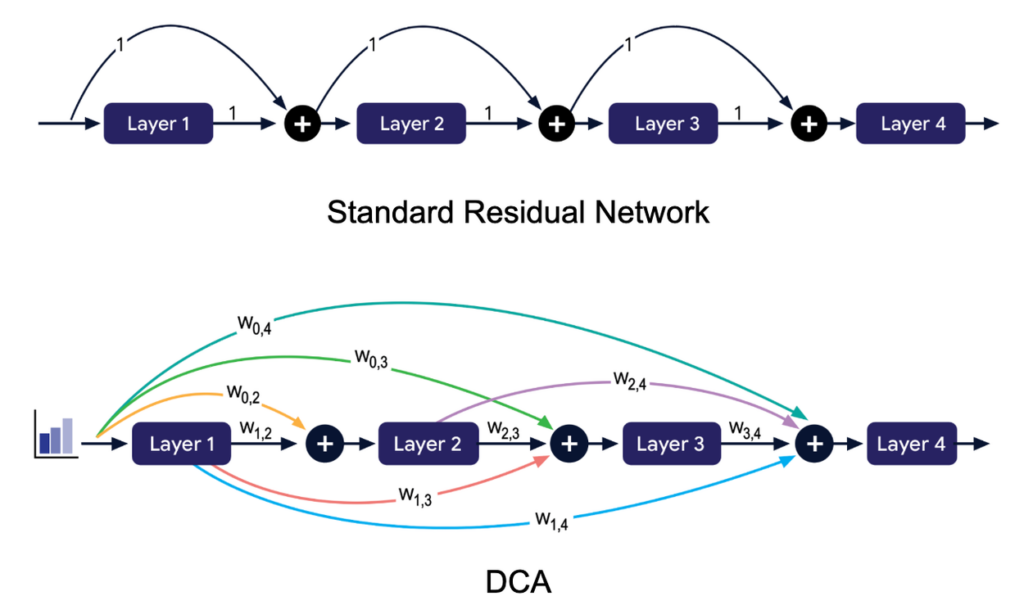
In a research post published on November 23, 2026, Google researchers described DeepCrossAttention (DCA), a method for changing how transformers pass information between layers. The work builds on their ICML 2025 paper.
Standard residual connections add a layer’s input to its output. DCA instead lets each token draw selectively from representations produced by earlier layers. Its routing weights combine a learned base with an input-dependent component, while depth-wise cross-attention retrieves information across layers rather than across tokens.
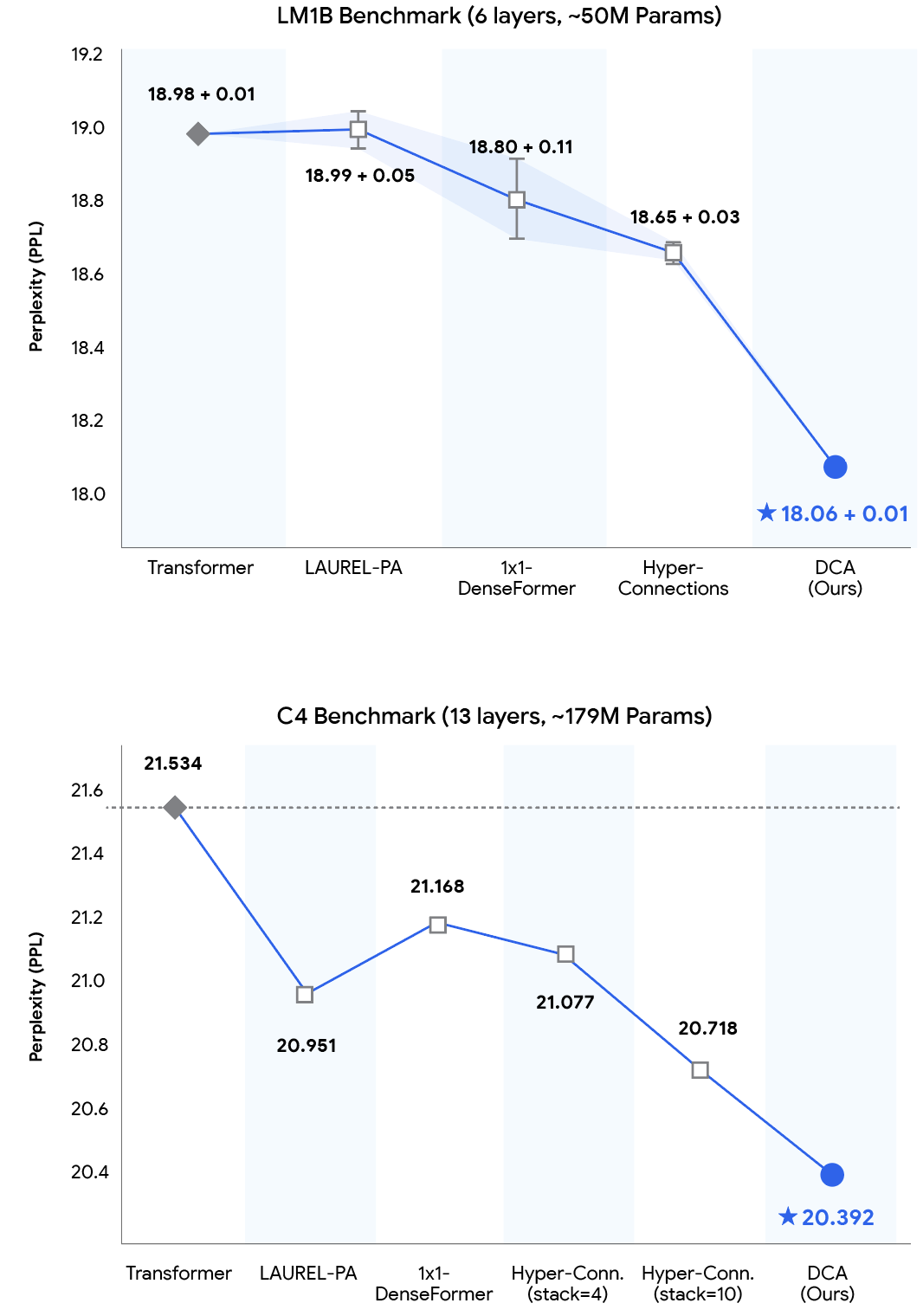
The researchers report that DCA reached the performance of standard transformers in up to five times fewer training steps on the LM1B and C4 language-modeling benchmarks. Under matched parameter and training budgets, it also produced lower perplexity—a measure of prediction error—than the transformer and other connection methods tested. On LM1B, a 30-layer DCA model achieved perplexity below 14, while a fixed-width standard transformer needed 42 layers to reach that threshold. The researchers describe this as a 29% reduction in depth and parameter count for that comparison.
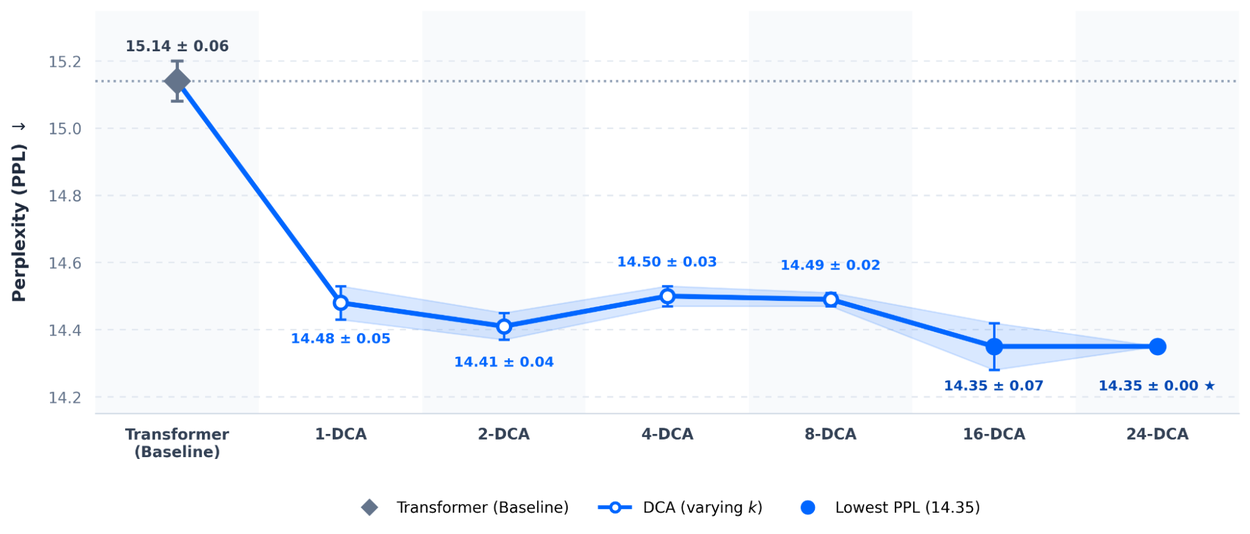
DCA’s routing components added less than 0.2% to total model parameters, according to the researchers, though accessing representations from multiple layers increased memory-bandwidth demands. They also report that adding DCA to an already pretrained transformer and continuing training briefly reduced LM1B perplexity by 0.19, compared with 0.02 from continuing standard training. These are reported experimental results, not a claim that DCA has been deployed in a consumer product.