A 141 GB model can fill a rack uplink during an update, yet a server running that same model can stream a chat response at about 120 kbit/s. For a small inference deployment, the question is how to keep the file transfer from stalling the conversation. A faster link between GPU servers may do nothing to help: if each server holds a complete model and handles each request on its own, the GPUs never need that link.
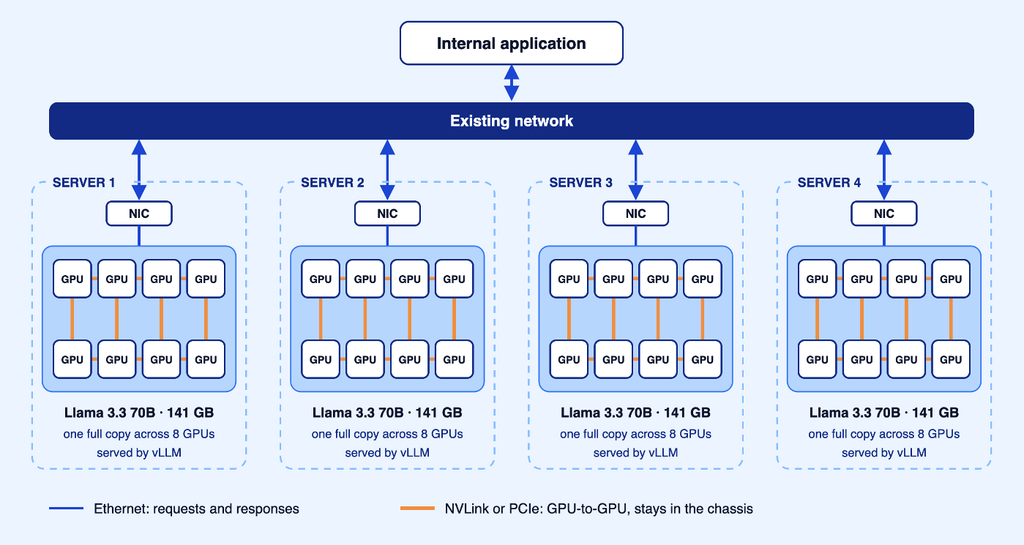
Sabina Anja, chief technologist at Broadcom, illustrates the distinction with a proposed setup for an internal application: four servers, each with eight GPUs and its own copy of Llama 3.3 70B, served by vLLM. The roughly 141 GB model file is too large for one 48 GB or 80 GB GPU, but it fits across the GPUs in one chassis. That makes the existing data centre network a reasonable starting point, provided its shared uplinks and proxies can handle two very different kinds of traffic.
Size for open conversations, not just bandwidth
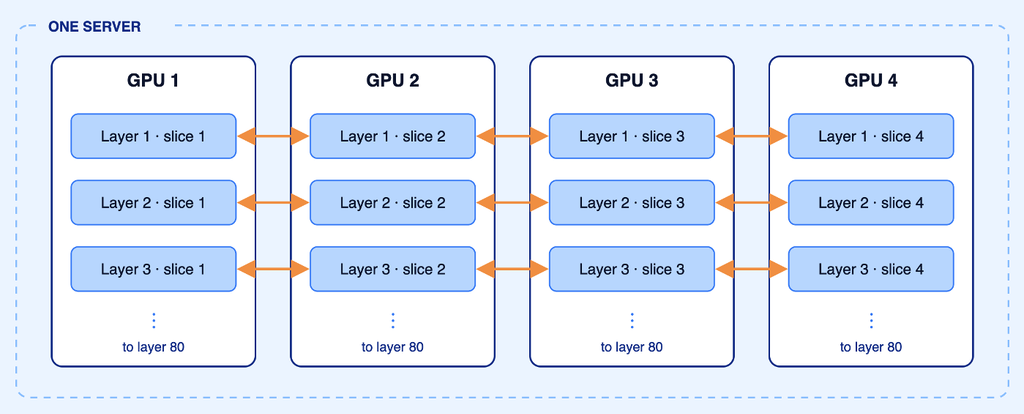
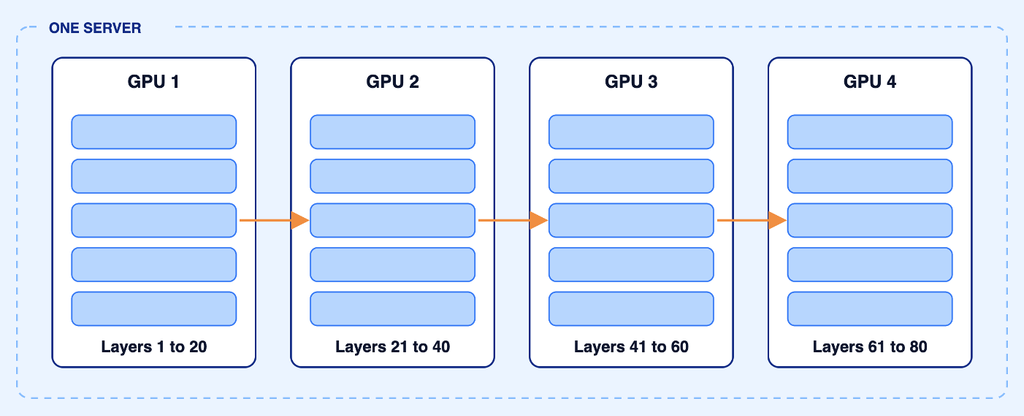
How vLLM splits the model matters inside the server. With tensor parallelism, each GPU holds a slice of every layer and exchanges partial results for every layer and token. That favours a fast interconnect such as NVLink. With pipeline parallelism, each GPU holds a block of complete layers, so data moves between GPUs only at the handoffs. vLLM recommends the latter for cards without NVLink, such as the L40S, to reduce communication overhead. Neither approach sends those exchanges through a rack switch in this design.
What the network sees during inference is an HTTPS request followed by a stream of small responses. At 300 bytes per message and 50 messages per second, even 1,000 streams amount to about 120 Mbit/s. GPU memory imposes a different limit: Anja estimates that an open stream occupies 1 to 10 GB, depending on conversation length. A server with a few hundred gigabytes free after loading the model could therefore support tens to a few hundred simultaneous streams. The proxy and firewall need to accommodate that many long-lived sessions, even when bandwidth use is low.
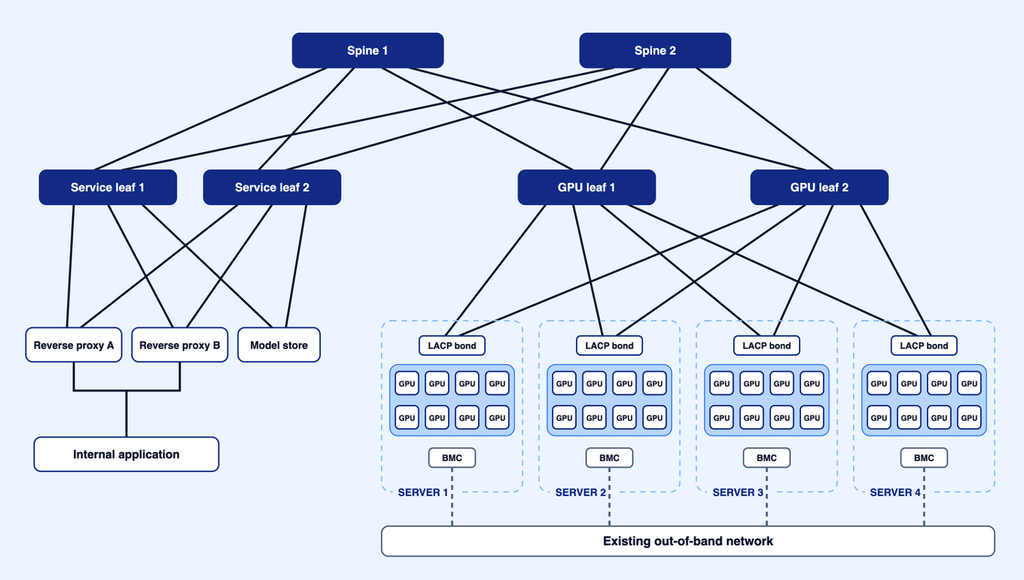
A pair of reverse proxies can balance individual requests rather than entire connections. The distinction matters because one HTTP/2 connection can carry several requests, and one request can cost a hundred times as much to serve as another. Anja recommends least-connections balancing over round robin and a consistent hash on a session identifier to keep a returning conversation on the server that has its cached state.
Proxy settings also affect what users see. Turning off response buffering in nginx lets text arrive as it is generated rather than in clumps. Its default 60-second timeout between reads, along with any firewall or network address translation idle timer, should accommodate the longest acceptable pause. A readiness check should establish that the model has loaded, not just that a port is open. Anja recommends probing /v1/models on vLLM; the llm-d project describes /health as a process check.
Protect the stream during a model update
Before buying switches, Anja recommends checking rack uplink speed, utilisation and oversubscription, along with available ports and support for traffic classification and separate queues. Her design connects each GPU server to a pair of leaf switches over 10 or 25 GbE links. Only the proxies should be able to reach the inference API. Model files and container images travel on a separate logical segment, but the two segments still share physical uplinks.
That distinction is most visible during a rollout. At line rate, ignoring protocol and storage overhead, a 141 GB transfer takes about 19 minutes at 1 GbE, 113 seconds at 10 GbE or 45 seconds at 25 GbE. A transfer can occupy a 10 GbE uplink for its full duration. A few hundred bytes of generated text need little bandwidth, but if they wait behind the file transfer, the user sees the answer pause.
The proposed quality-of-service policy gives interactive responses their own queue on shared leaf uplinks and spine ports, separate from network control traffic. Bulk transfers get the lowest queue weight and a rate limit at the model store. On a VXLAN network, operators should verify that traffic markings are copied to the outer packet header; otherwise, spine switches cannot distinguish the two classes.
Keeping the weights and container images in an internal store avoids repeated internet downloads. A local NVMe copy on each server also lets a restarted process reload from disk. The large model file then needs to cross the rack uplink only at installation or when its version changes, and updating one server at a time limits competing transfers.
When to revisit the network
The buying decision changes when GPU data must move between servers. That happens if the model outgrows one chassis or fine-tuning spans several nodes. It can also happen with a model that still fits: vLLM has an experimental mode that hands cached state from one instance to another while serving a single request.
For distributed execution, vLLM recommends InfiniBand-class adapters and warns that its inter-server traffic is unencrypted and can expose systems to code execution. That is a different performance and security problem from delivering HTTPS responses. For independent replicas, a dedicated 400G fabric and the operational work of running remote direct memory access over Ethernet need not be the starting point. The reason to reconsider is a change in what crosses the network, not simply the addition of another GPU server.