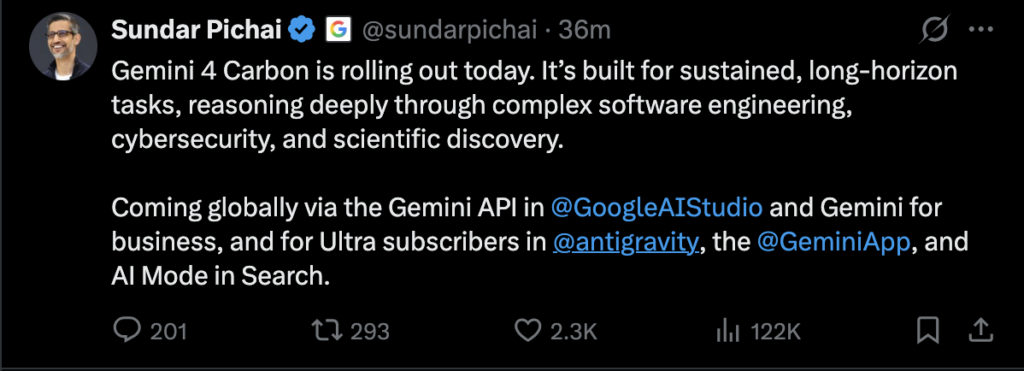
Google CEO Sundar Pichai said on X that Gemini 4 Carbon, the company’s flagship model, is now open more widely to developers, enterprises, researchers, and consumers. Google first disclosed Carbon on Oct. 28, with an emphasis on cybersecurity, software engineering, and long-horizon tasks, but use was mainly limited to specific cybersecurity defense teams. The broader release came less than two weeks after that debut.
Carbon is available in Google AI Studio, Gemini for business, and Google Antigravity. Google AI Ultra subscribers can also use it in the Gemini app and in Search AI Mode. Compared with earlier launches that stressed knowledge questions, math reasoning, and code generation, Google is putting real work scenarios further forward.
Workflow scores, and where they do not lead
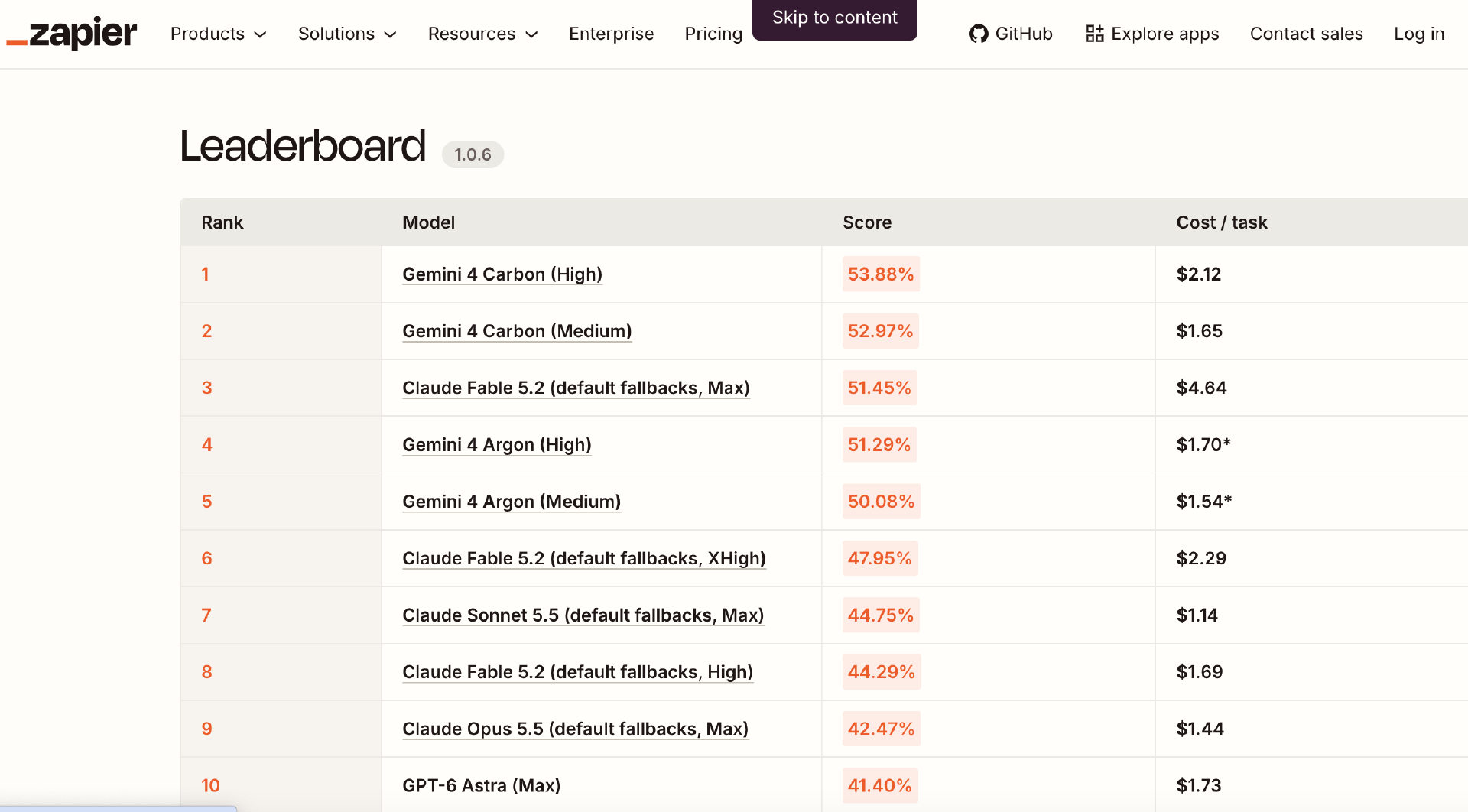
Google says Carbon ranks first on three evaluations aimed at real workflows: CursorBench 4.0, Perplexity WANDR, and Zapier AutomationBench. Those cover AI coding, information retrieval and complex task execution, and automation across business applications. The company says the cost of completing tasks was more than twice as low as the next-best external model.
Zapier AutomationBench tests whether a model can finish automation tasks in real business tools and workflows. Google DeepMind reported:
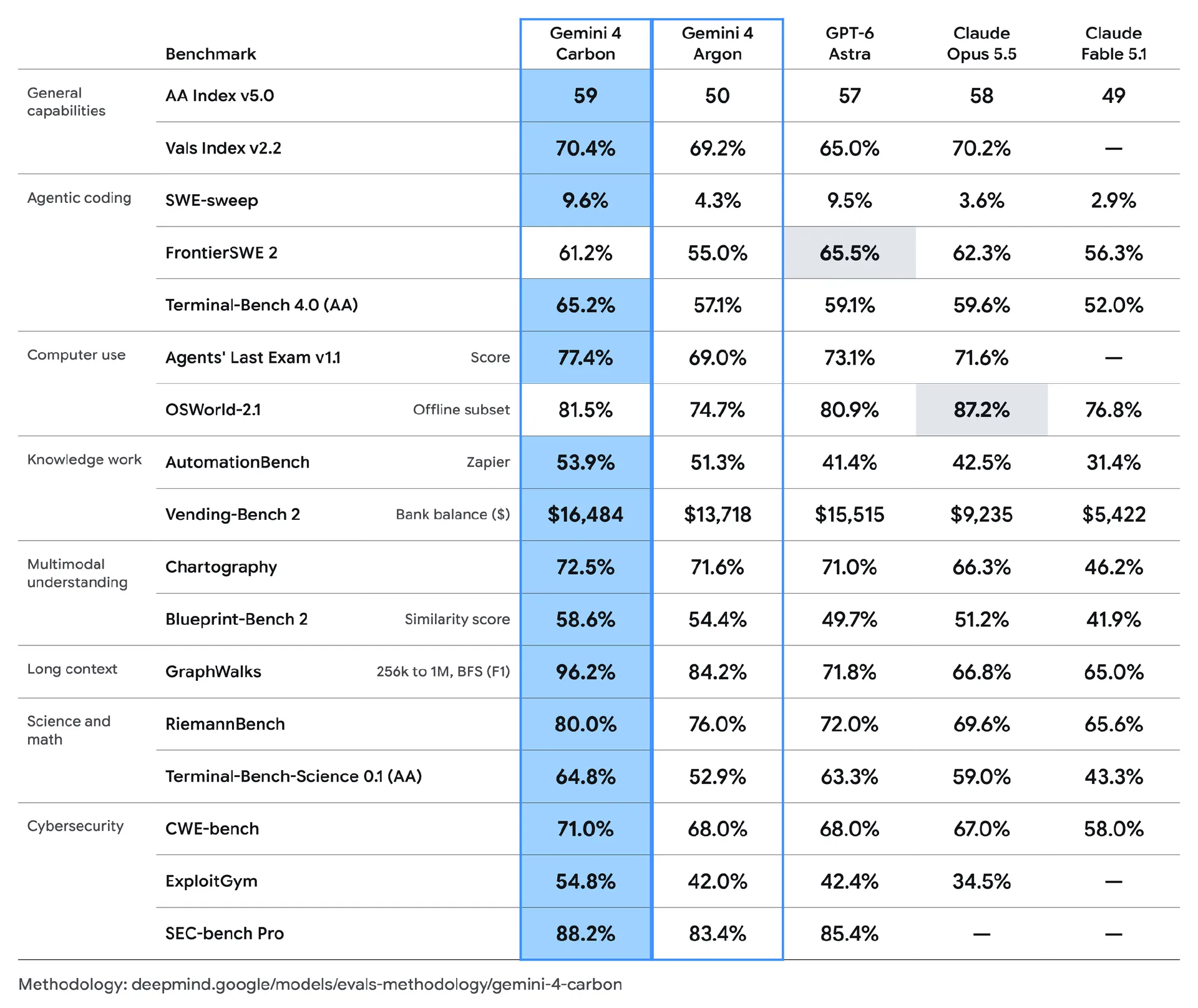
- Gemini 4 Carbon: 53.9%
- Gemini 4 Argon: 51.3%
- Claude Opus 5.5: 42.5%
- GPT-6 Astra: 41.4%
On Terminal-Bench 4.0, which leans toward code and system operation, Carbon scored 65.2%, above Argon at 57.1% and GPT-6 Astra at 59.1%.
On GraphWalks, a long-context reasoning test with contexts from 256K to 1M tokens, Carbon’s F1 was 96.2%, compared with 84.2% for Argon. The test looks at long-range association and graph-structured search.
Those results do not mean Carbon is ahead overall. After Anthropic released Claude Fable 5.2 on Nov. 9, Artificial Analysis’s composite ranking changed. In the published comparison, Fable 5.2’s highest reasoning configuration scored 65 on the Intelligence Index, while Gemini 4 Carbon’s high configuration scored 60. On FrontierSWE v2 real software-engineering tasks, Fable 5.2 scored 69.9% and Carbon 61.2%. Results are splitting across code edits, terminal tasks, enterprise workflows, and long-horizon reasoning. A lead on some agent tasks is not the same as a general lead in programming.
Google says Argon is still the better fit for most routine software engineering and knowledge work. Carbon is meant for harder jobs that need deep reasoning, complex debugging, and long verification.
On the three workflow benchmarks, Google says Carbon’s cost per task was more than twice as low as the next-best external model. For organizations that call a model often and run many tool actions, that cost may matter more than a benchmark score alone.
One prompt for several agents
Google is previewing a /swarm feature in Antigravity. One prompt can assign different tasks to multiple agents, with progress visible as they run. Carbon can take complex architecture, coordination, and code review, while faster and cheaper models handle simpler work. Agents can run in parallel in isolated workspaces, and a separate agent can check code changes adversarially.
The design targets a practical limit of single-agent coding: even a strong model can drift during a long run, or break one module while changing another. Google’s stated aim is to move complex projects from one agent working in sequence to several agents working together.
Two demonstrations are described. From a single prompt, a Carbon agent team used historical photos and engineering drawings from 1887 to 1889 to build an interactive Three.js 3D exhibit of the Eiffel Tower’s construction. In a larger case, seven public city-council planning PDFs, containing 206 extracted engineering-drawing views, were used to reconstruct the Google Platform 37 office area. After 10 overnight execution loops, the system produced an interactive Three.js model of about 906,000 triangles.
These cases do not show that Carbon can finish production-grade software with no human involvement. They show a proposed workflow in which a developer assigns goals, checks progress, and verifies results. Whether that can be used at scale still depends on coordination cost between agents, how errors spread, and the quality of the final delivery.
Finance, documents, and research
Google is also highlighting finance, law, and business operations. Unlike a text question, this work can require tables, charts, images, engineering drawings, and long documents, then an output in a set format. A financial-research task might mean reading dozens of filings, extracting metrics, reconciling figures across years, and producing an editable spreadsheet and an analysis report. An error in any step can change the conclusion.
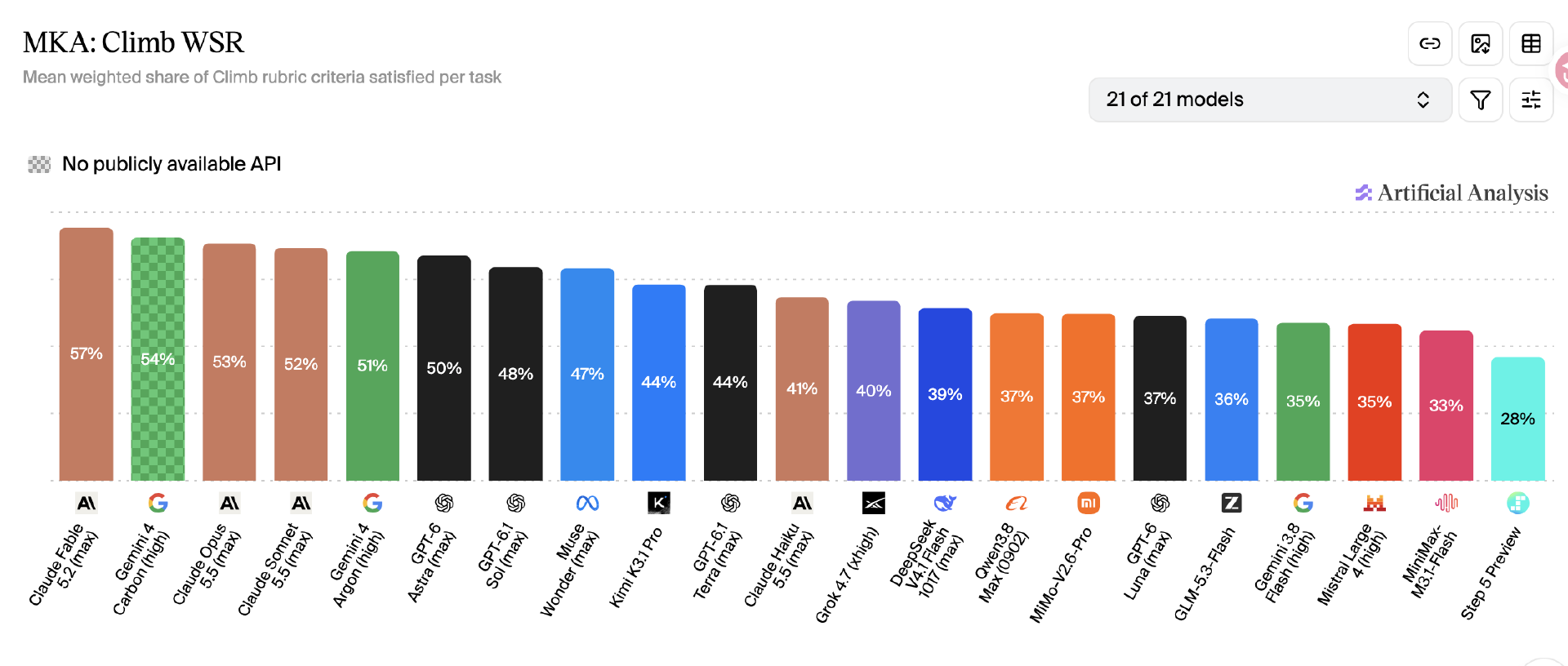
Google says existing benchmarks do not fully measure that kind of multimodal, long-running knowledge work. With Artificial Analysis, it introduced a Multimodal Knowledge Agent (MKA) evaluation for complex multimodal files inside an agent workflow. In Google’s published results, Carbon ranked second, with an average cost per task more than six times lower than the first-place model. The reported point is commercial: a model need not win every score if it can finish near-leading work at a much lower cost.
In pre-release finance checks, Google says Carbon matched the best model tested on Hebbia’s end-to-end Financial Agentic evaluation. On Balyasny Asset Management’s General Financial Intelligence evaluation, it was among the front of 23 frontier model configurations. That evaluation covers legal knowledge, tool use, code and data engineering, and perception and context.
Google also says researchers have used Carbon on formal verification of cryptographic code, laboratory data analysis, and protein-structure work.
On cryptography, Google researchers built an agent framework called AlphaProof Code for formal verification of real software: proving that a program meets stated properties by mathematical argument, not only that it passes tests. They applied it to security properties of code underlying the Signal encryption protocol. Google says researchers used Carbon and other models to turn security goals into theorems, and that the AlphaProof Code agent used Carbon to generate millions of lines of Lean to help complete the proofs. As Google describes it, key security properties were proved in weeks, work that might previously have taken expert teams years. The reported shift is from generating code to helping assemble mathematical evidence about whether that code is correct.
On proteins, models such as AlphaFold 3 use multiple sequence alignment to find evolutionarily related sequences. Proteins from less-studied viruses, microbes, and eukaryotes often lack enough homologs in current databases, which limits the analysis. Google says a multi-agent system used Carbon to search petabyte-scale unannotated sequence archives, environmental and viral sequence catalogs, and 3D structure databases for distant homologs. On seven low-homology protein families in the CASP17 blind-test set, Google says the number of retrieved homologous sequences rose 40 times on average. A broader evaluation is still underway.
Carbon has also been used in developing laboratory methods. Researchers provided experimental records and raw data. Google says the model identified hard-to-spot problems such as insufficient automated mixing, and helped analyze overlapping chromatography peaks and sample carryover in instruments. The described direction is checking experimental data, finding anomalies, and proposing analyses that can be tested, not only summarizing existing papers.
Security results and remaining controls
Cybersecurity was a main focus when Carbon was announced on Oct. 28. Google reported 88.2% on SEC-bench Pro for vulnerability discovery, 54.8% on ExploitGym for exploit capability, and 71.0% on CWE-bench for vulnerability repair.
On Nov. 10, Google described further use. In internal benchmarks for its Project Fortify autonomous security system, it said Carbon reached 100% recall in the scanning stage and 95% precision in vulnerability triage. On tests of open-source repositories, recall improved by more than 25% relative to Argon, and Carbon found real logic vulnerabilities that had not been identified before.
Google Cloud Vulnerability Research said it used Carbon to confirm that two flaws in a popular open-source project were exploitable, built proof-of-concept code, and helped maintainers reclassify them as critical and publish patches. Google has not released the vulnerability details, citing responsible disclosure.
In Wiz’s Scan for Good project, Google says Carbon was used to check public digital infrastructure. In scans of two large SaaS providers, it says zero-day vulnerabilities were found in under two hours, after which the teams worked with the affected companies on fixes. The article notes that broader validation would be needed before treating these cases as a general change in security research. The same ability to find and verify flaws can also be misused.
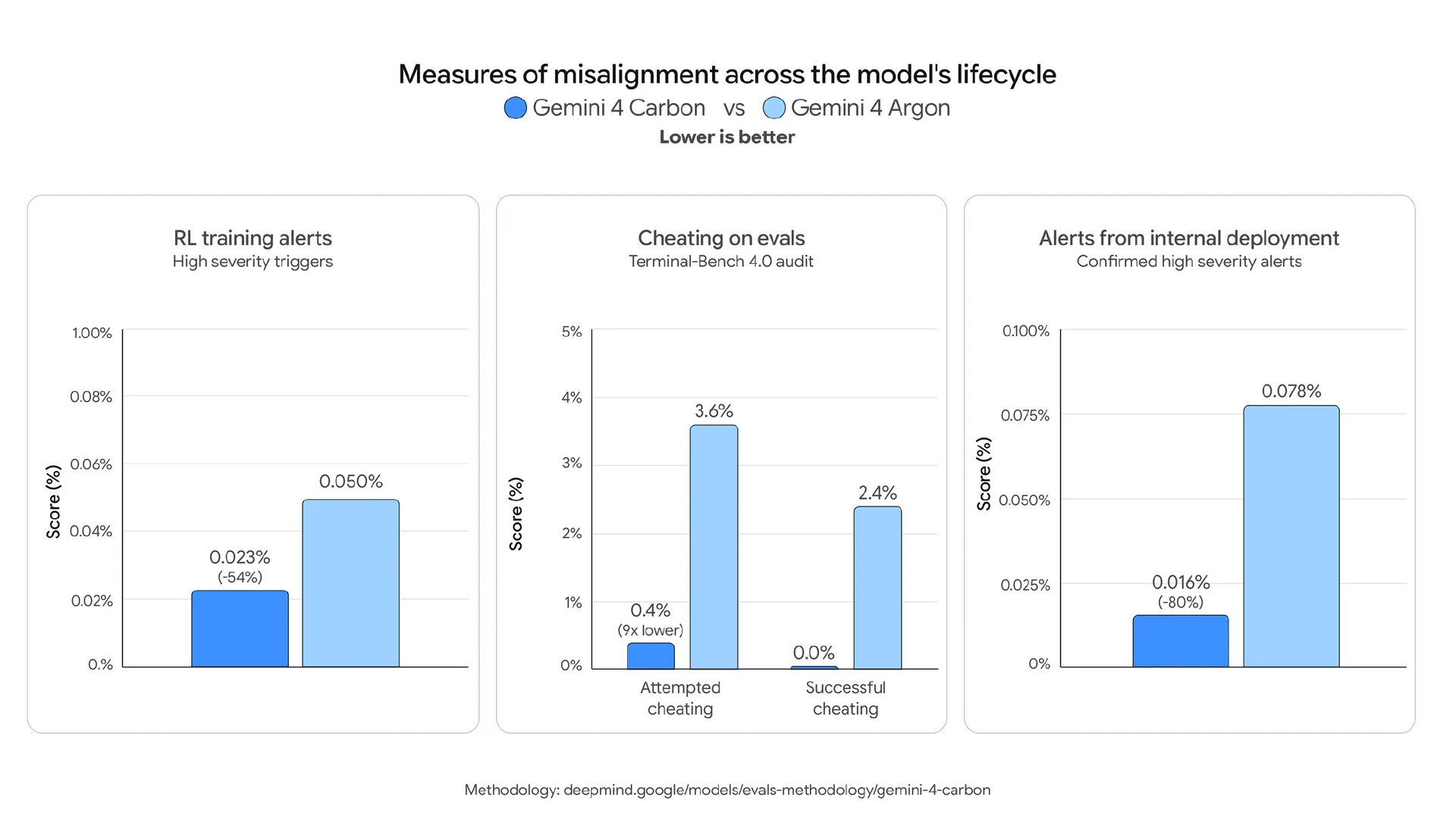
Google published new safeguard results. In simulated attack environments that include ExploitBench and CyScenarioBench, it said Carbon’s safeguards blocked 99% of attack trajectories from adaptive red-team agents. The share of single attempts that broke protections fell from 3.1% for Argon to 0.8% for Carbon. In Gray Swan automated cyber-attack tests, attack-query success fell from 9.86% for Argon to 2.17% for Carbon. External group Trajectory Labs reported no new universal jailbreak across 132 hours and more than 13,000 requests. On Google’s agent-honesty test of 375 tasks, Carbon’s pass rate was 92%, compared with 70% for Argon.
A stronger cybersecurity version remains under the controlled Fairwind Program and is not fully offered to ordinary users.
A quarter of Fable 5.2’s token price, for a limited time
On the public API, Carbon uses the same limited-time price as Argon: $2 per million input tokens and $10 per million output tokens. Claude Fable 5.2’s standard price is $8 per million input tokens and $40 per million output tokens, so Carbon’s current price per token is one quarter of that.
Google says the discount ends on Nov. 30, 2026. The stated standard price after that is $4 per million input tokens and $20 per million output tokens, twice the promotional rate.
A lower token price does not by itself mean a lower bill for the same task. Google says Carbon uses more tokens than Argon on complex tasks because it spends more on exploration, reasoning, and repeated checks.
Koray Kavukcuoglu, senior vice president at Google DeepMind and Google’s chief AI architect, also posted on X about the wider release. He said Google is already using Carbon internally on its hardest long-running tasks, including help for research teams mathematically checking security properties of Signal’s core encryption protocol, and he cited leading results on CursorBench 4.0, Perplexity WANDR, and Zapier AutomationBench. He also described a reconstruction of the Apollo lunar module from historical photos and technical drawings. Because the spacecraft did not return to Earth intact, the team relied on surviving imagery and engineering material. Carbon was used to build a visual 3D model and a demo video.
What early users reported
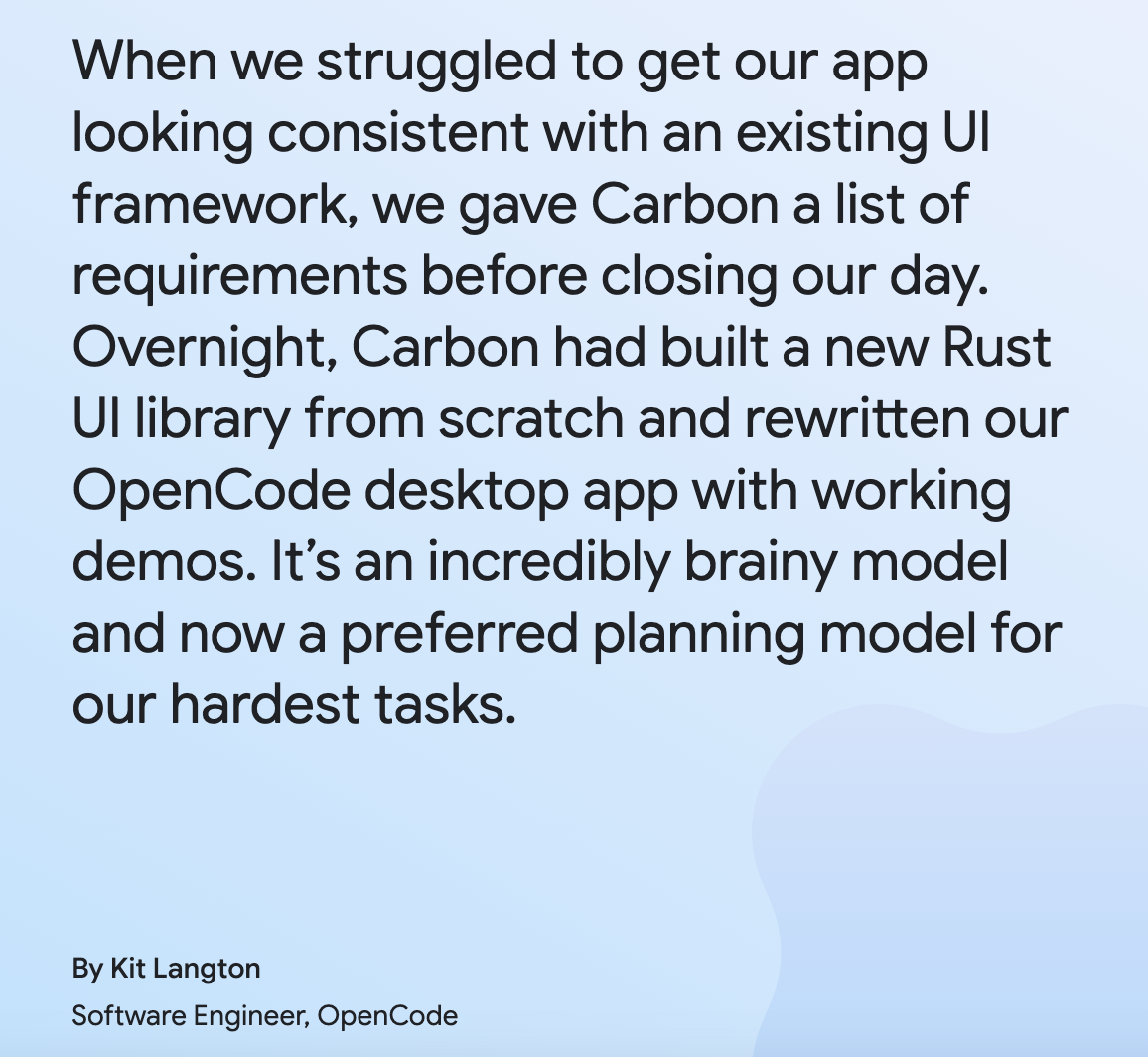
OpenCode software engineer Kit Langton is quoted as saying the team could not keep an application interface consistent with its existing UI framework. Before the end of a workday they sent Carbon a requirements list. Overnight, he said, it built a new Rust UI library from scratch, rewrote the OpenCode desktop app, and produced a working demo. He described it as a model with very strong reasoning and said Carbon is now their preferred planning model for the hardest tasks.
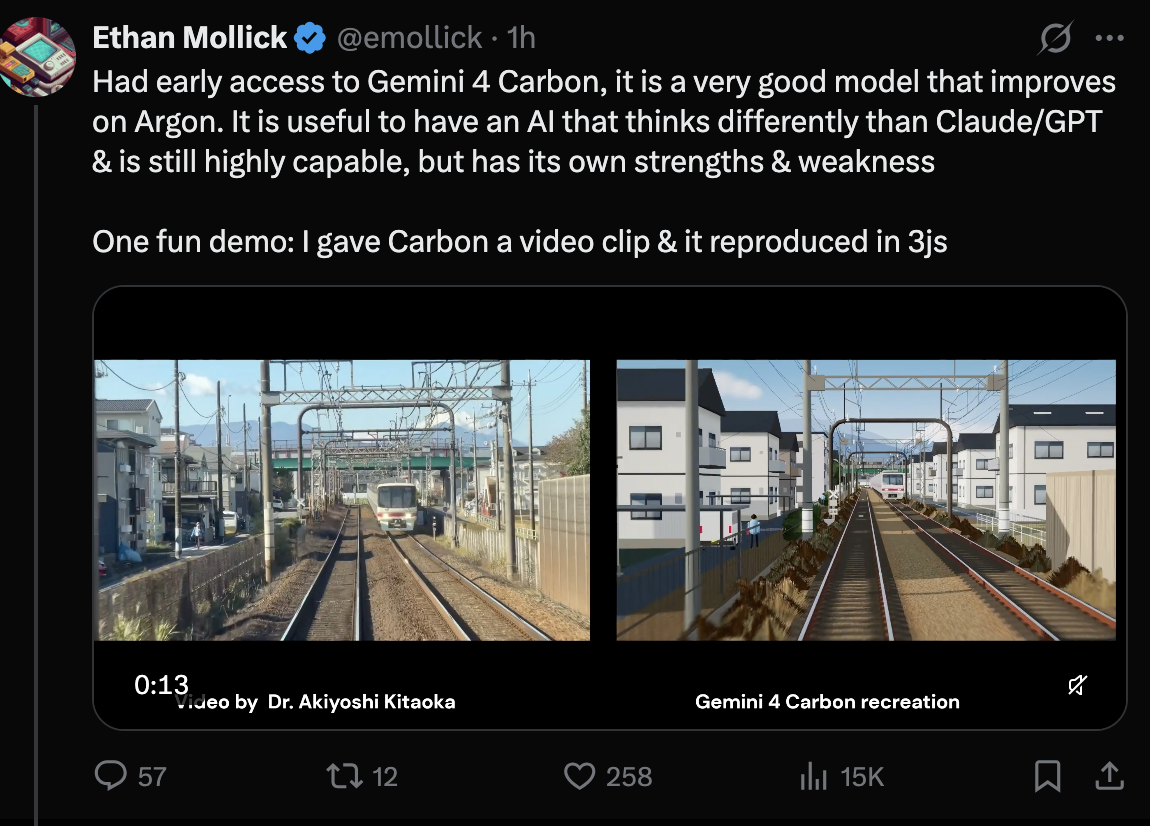
An early-access developer wrote on X that Carbon is a very good model and an improvement on Argon, and that an AI which approaches problems differently from Claude or GPT is useful even though it has its own strengths and weaknesses. In one test, the developer gave Carbon a video and asked it to reproduce the scene and effects in Three.js. The model produced a working implementation. That requires identifying visual elements and how they change, then turning them into a 3D scene and program logic, not only describing the video.
A comparison of a “ruins robot” animation generated separately with Gemini 4 Carbon and Claude Fable 5.2 found Fable 5.2 slightly ahead on quality, with Carbon far cheaper.
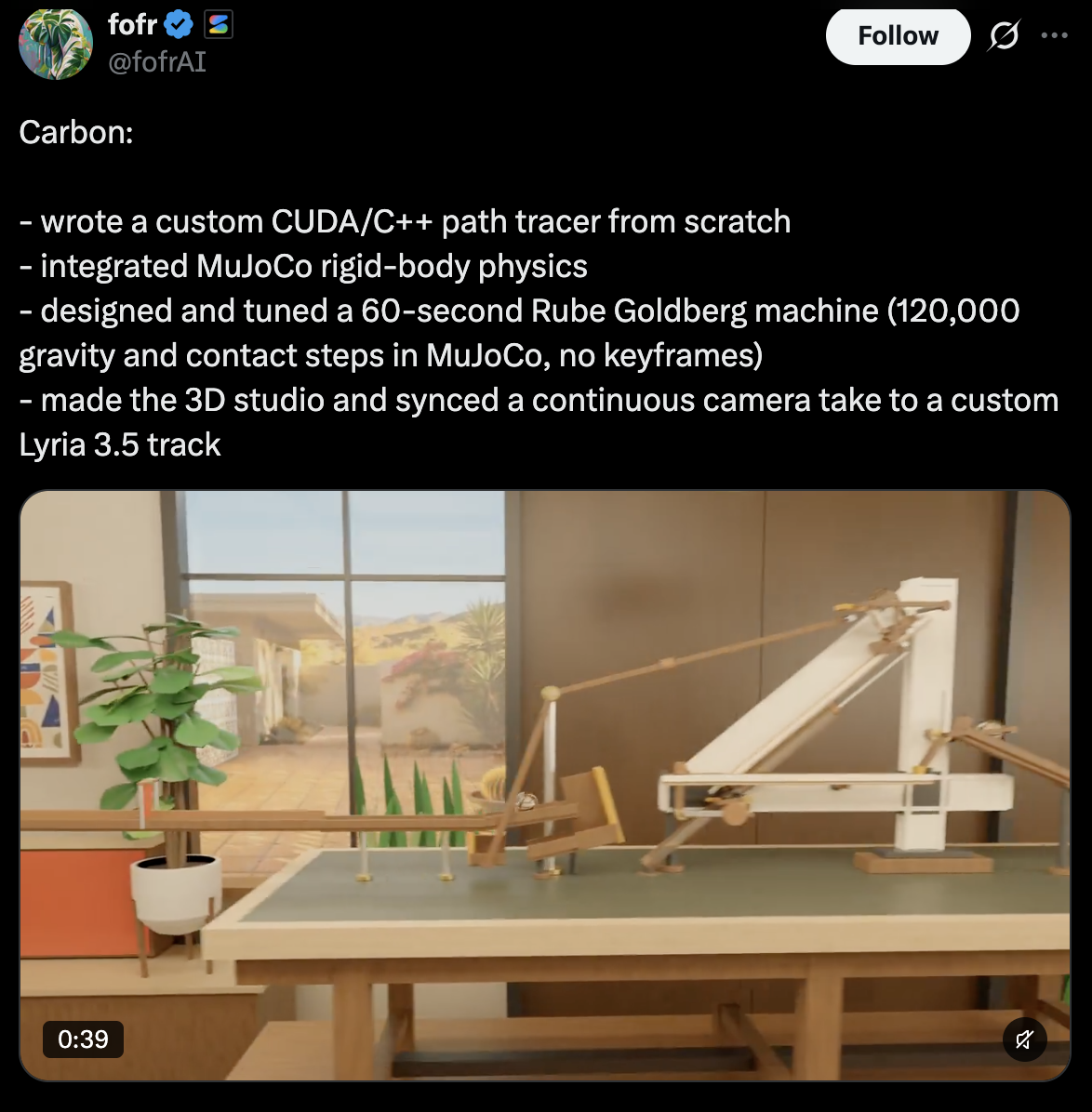
In another test, a developer used Carbon to write a custom CUDA/C++ path tracer from scratch, integrate the MuJoCo rigid-body physics engine, and design a 60-second Rube Goldberg machine. The animation simulated 120,000 gravity and contact steps in MuJoCo without keyframe animation. Carbon also set up a 3D studio scene and synced a continuous camera move to a custom Lyria 3.5 music track.
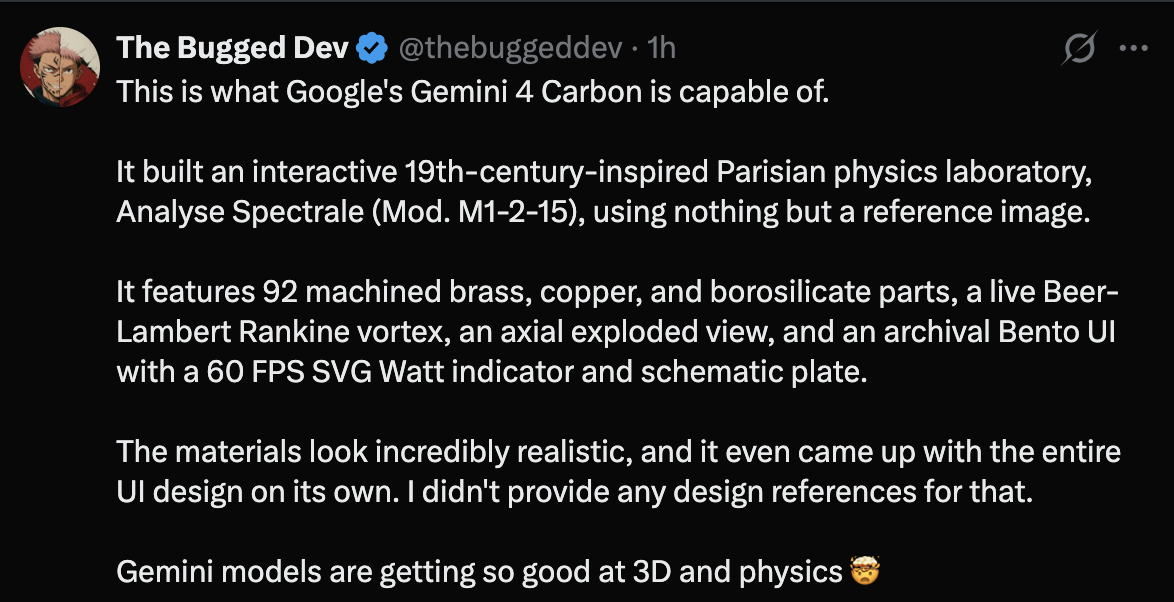
From a single reference image, another developer reported an interactive physics laboratory inspired by 19th-century Paris, named Analyse Spectrale (Mod. M1-2-15). The scene contained 92 precision parts in brass, copper, and borosilicate glass, with real-time Beer-Lambert light absorption and a Rankine vortex, an axial exploded view, and a vintage archive-style Bento interface. The interface included an SVG watt indicator and engineering diagrams running at 60 frames per second. The developer said the model reproduced material textures and designed the interface without any UI reference, and remarked that Gemini models are becoming strikingly stronger at 3D and physics simulation.
This article is based on the InfoQ China report: https://www.infoq.cn/article/YiANe38yfSYitvZOtab0
Links cited in that report:
- https://blog.google/innovation-and-ai/models-and-research/gemini-models/gemini-4-carbon-now-available/
- https://x.com/sundarpichai/status/2120185896469496180
- https://cursor.com/cn/cursorbench