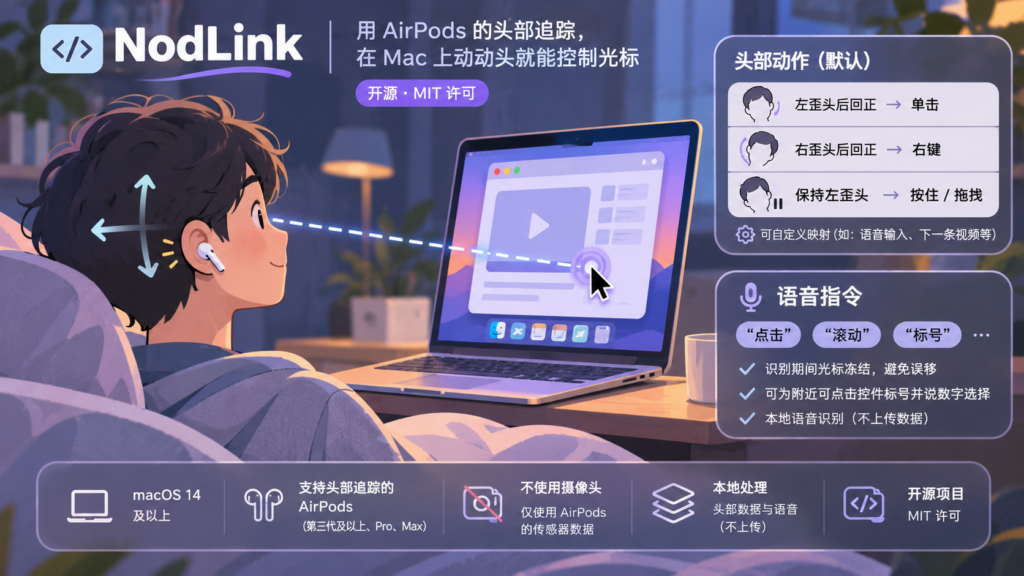
In a November 8, 2026 article, developer Uinui described NodLink, an open-source project that uses head-tracking data from AirPods to control a Mac’s pointer. The aim is to make computer use easier for people who have difficulty operating a mouse or keyboard.
After calibration, turning your head moves the pointer across the screen. Tilting left and returning to center triggers a click by default; tilting right triggers a right-click. Holding a left tilt can hold the mouse button for dragging. Users can remap those gestures—for example, to activate dictation or advance to the next video.
NodLink also accepts spoken commands, including clicks and scrolling. According to Uinui, it freezes the pointer while recognizing a command so a small head movement does not change the target. A numbering feature can label nearby clickable controls for selection by voice. Voice recognition and the head-tracking data are processed locally, the author says; the app does not use a camera.
The project requires a Mac running macOS 14 or later and head-tracking AirPods: third-generation or newer standard AirPods, AirPods Pro, or AirPods Max. Uinui says a Swift program reads the headphone data and controls the system pointer, while a web-based console built with Node.js and three.js handles calibration, filtering, gestures, and a 3D display. NodLink is released under the MIT license.
It remains a project with practical limits. Setup currently requires Terminal and Node.js, voice commands can be misheard, and pointer direction can drift over time; NodLink provides a voice command or keyboard shortcut to recenter it. Uinui demonstrated hands-free use in practice scenes and on a video website, but did not present a broader accessibility evaluation. A proposed iPhone version involving an ESP32 Bluetooth board is a future plan, not a feature of the current Mac project.