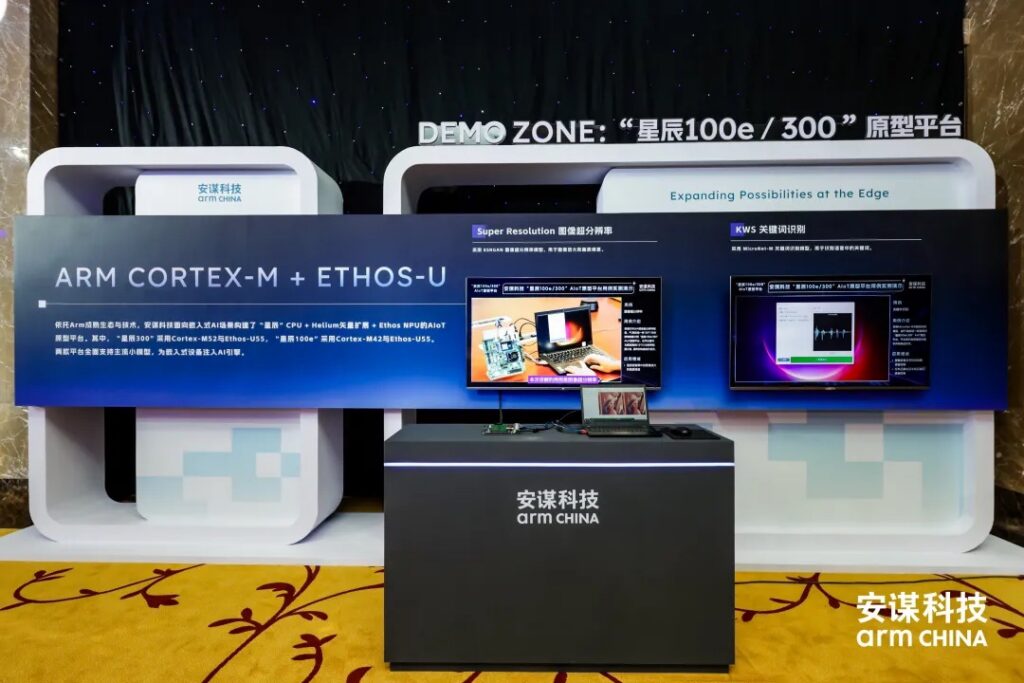
At a November 18, 2026, product briefing, Arm Technology (China) introduced the “Star 100e” AIoT prototype platform, combining an Arm Cortex-M42 CPU with an Ethos-U55 processor. The company said it had built the system on an FPGA platform and run keyword detection, object recognition and speech recognition workloads.
Cortex-M42 is designed for cost- and area-sensitive smart endpoint devices. Based on Armv8.1-M, it includes Arm Helium for vector processing, support for Arm Custom Instructions and a compact AHB-based design intended to fit existing microcontroller architectures without a complex memory subsystem.
Arm said Cortex-M42 offers a smaller, lower-power option than Cortex-M52 for designs that do not need features such as optional caches or tightly coupled memory. In a configuration using TSMC’s 22ULL process at 150 MHz, the company reported similar scalar and vector performance to Cortex-M52, with 10% less silicon area and 15% lower power consumption.
Arm Technology (China) and Arm jointly developed the processor. It is named “Star” STAR-MC3 in China and has been added to Arm’s global Cortex-M product roadmap.
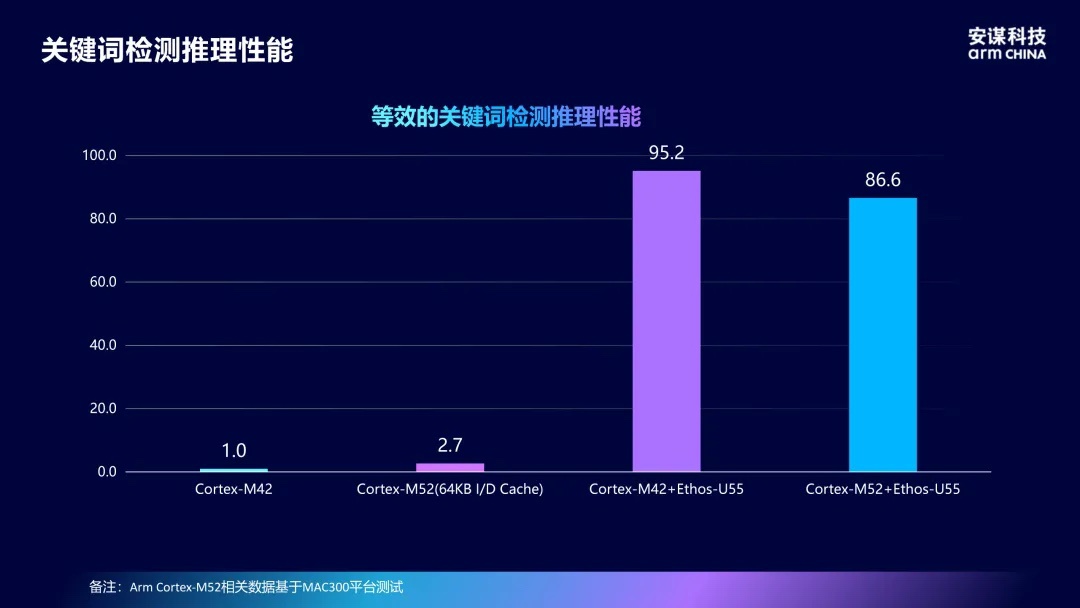
According to reported test results for the prototype, pairing Cortex-M42 with Ethos-U55 increased keyword-detection inference performance by 95 times, object-recognition inference performance by more than 132 times and automatic speech-recognition performance by more than 340 times, compared with Cortex-M42 alone. These are workload-specific comparisons reported for the prototype, not general performance figures for deployed devices.
The earlier “Star 300” platform uses Cortex-M52, known as STAR-MC2 in China, with Ethos-U55. The company said it planned a higher-performance next-generation Star prototype platform for 2027.