As of November 19, 2026, Red Hat was positioning its AI platform around a problem for enterprise IT teams: models change quickly, but the GPU infrastructure, data connections and business workflows around them cannot be rebuilt every time a new model appears. Victor Tsao, Red Hat’s vice president and president for Greater China, said CIOs need a platform that can accommodate those changes rather than simply selecting the best model available at one moment.
Red Hat describes its approach as supporting different accelerators, clouds, models and agents. According to the company, its platform supports more than 20 open-source models across more than 700 versions. Its accelerator support includes NVIDIA, Intel, AMD and Chinese GPU maker MetaX, while work on other domestic accelerators continues.
The cost of producing tokens
Aella Wang, general manager of Red Hat Greater China’s solutions architecture department, described a progression from centrally managed GPUs to shared inference services and, ultimately, models offered as a service to business teams. Tsao noted that falling prices per token do not necessarily mean lower total bills: reasoning models and agents can consume more tokens through repeated inference, tool use and verification.
Red Hat is involved in the open-source vLLM project and is promoting llm-d for distributed inference. Released on October 20, 2026, llm-d 1.0 added capabilities intended for production use, including multitenant resource management, request priorities, high availability, rolling upgrades and session-aware routing for agent workflows.
An IBM Research benchmark using llm-d deployed a model of approximately 753 billion parameters. Under its parallel agent workload, it supported up to 3,000 concurrent coding agents and reached peak output above 6.6 million tokens per minute. IBM estimated a per-token cost five to ten times lower than comparable commercial APIs using the cloud rental prices assumed in that test. That result does not establish that self-hosting is cheaper for every enterprise: utilization, staffing, electricity and maintenance also affect the cost of completing a task.
Controlling what agents can do
Wang said building a task-specific agent may be relatively easy, but governing its access is harder. An agent used for IT operations could potentially change server settings, run scripts or delete a database. Enterprises therefore need to decide which tools and data an agent may access, which actions require human approval, and how its operations are audited.
Red Hat AI 3.5 adds model safety evaluation, agent development templates, tool-call safeguards and observability. Its EvalHub is intended to help assess models and agents, while NeMo Guardrails is used to constrain their behavior. The platform also adds per-user token-usage tracking. In a 2026 survey report published by Red Hat and CIO Times, nearly 70% of responding enterprises were advancing agent applications, but fewer than 15% had formal governance frameworks in place.
Patching without a full upgrade
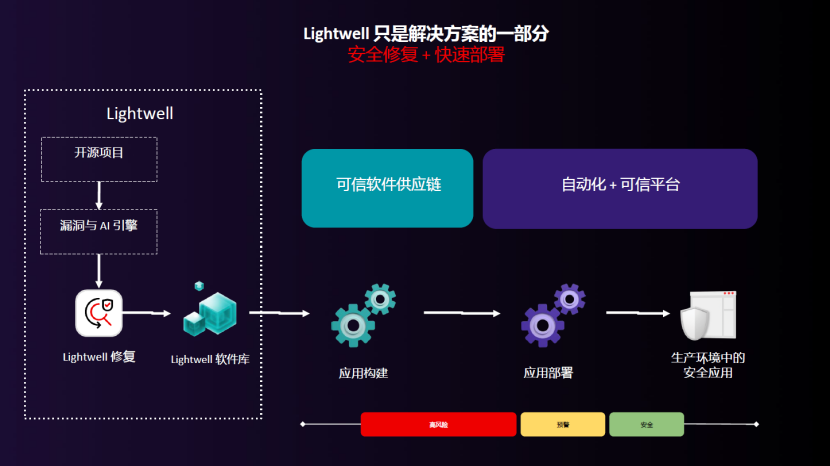
Red Hat and IBM are also pursuing AI-assisted vulnerability identification and repair through Lightwell. Engineers participate in validating fixes and backporting patches to versions enterprises already use, an approach intended to reduce the compatibility risks of upgrading an entire software stack.
On October 6, 2026, IBM and Red Hat said Lightwell had found and fixed more than 400 previously unknown vulnerabilities in widely used Java libraries. They also said Lightwell Clearinghouse had become generally available, allowing enterprises to submit software dependencies for prioritized review and repair. Wang said automated processes could reduce a patch deployment that traditionally takes more than 40 days to seven to 14 days; that comparison was her estimate, not a guarantee for every environment.
Tsao acknowledged that, despite substantial AI spending, there are still relatively few enterprise cases with demonstrable returns. The question for Red Hat’s platform is whether its gains in inference efficiency, operational control and patching can translate into measurable results in production systems.