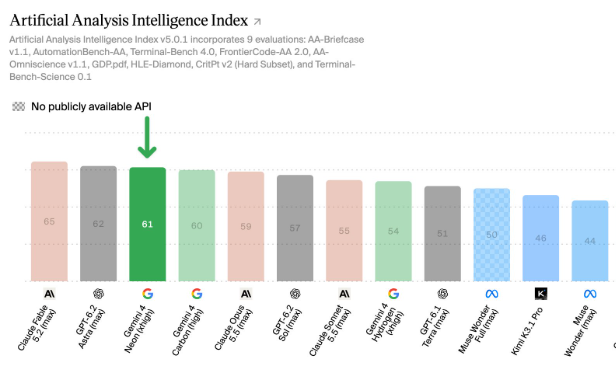
In reporting published on November 20, 2026, Google’s Gemini 4 Neon was presented as a faster option for demanding coding and knowledge-work tasks. The model launched on November 18, eight days after Carbon became available to developers. It was Google DeepMind’s fourth model release in roughly seven weeks, following Argon, Carbon and Hydrogen.
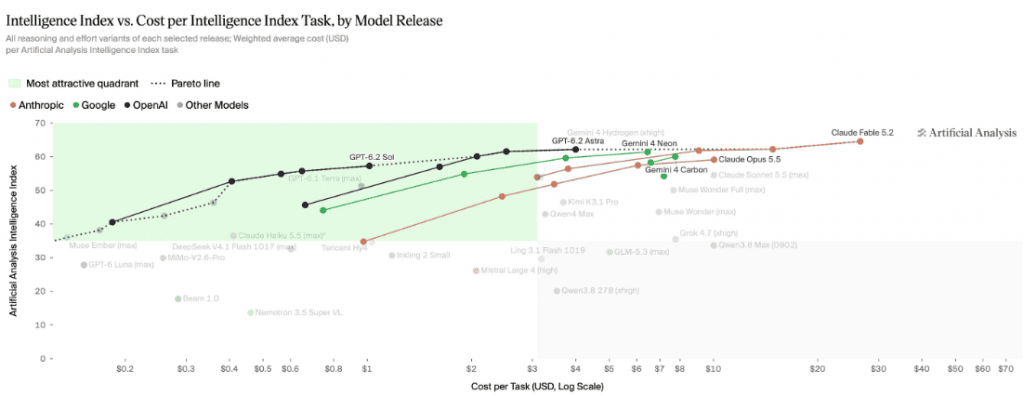
Artificial Analysis rated Neon and Carbon at 60 on its Intelligence Index when both used the high reasoning setting. Neon reached one point above Carbon’s high-setting score at its xhigh setting, placing it in the index’s top three. According to Artificial Analysis, Neon also completed its evaluations at lower cost and in less time than Carbon.
Cost, speed and capabilities
At the high setting, Artificial Analysis calculated an average evaluation-task cost of $3.74 for Neon, compared with $7.76 for Carbon at its standard price. Neon’s xhigh cost was $6.44 per task—about 17% below that Carbon comparison. It measured Neon generating approximately 110 tokens per second, nearly twice Carbon’s rate. Although Neon generated about 15% more tokens per task on average, it finished tasks roughly 40% faster.
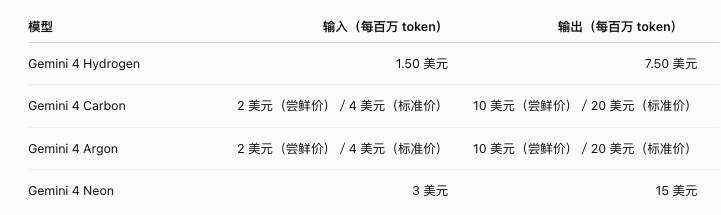
Neon is priced at $3 per million input tokens and $15 per million output tokens, twice Hydrogen’s respective rates. Carbon and Argon had introductory prices of $2 and $10 per million input and output tokens through November 30; their stated standard prices from December 1 were $4 and $20. The introductory prices were therefore lower than Neon’s, even though Carbon’s standard price was higher.
Artificial Analysis identified agent-based knowledge work and visual reasoning as areas of improvement. On its AA-Briefcase evaluation, Neon at xhigh scored 1700 Elo, versus 1611 for Carbon, while remaining below Claude Fable 5.2 at 1785 and Claude Sonnet 5.5 at 1815. Neon’s presentation-quality score reached 1771 Elo, which Artificial Analysis described as a record for that category. Results varied by evaluation and setting: on GDP.pdf, Neon scored 33.4% at high but 28.0% at xhigh.
Neon has an approximately one-million-token context window and can output up to one million tokens. It accepts text, images, video, audio and PDFs, and supports computer use, code execution and file search. It can also use information from Google Search and Maps to produce grounded answers. It does not currently generate images or audio.
Coding results depend on the tooling
Google reported that Neon at its default high setting scored 65.2% on Terminal-Bench 4.1 and 46.2% on FrontierCode 2.0. On SWE-sweep, Neon solved 12.8% of tasks with the shared mini-SWE Harness and 39.0% when connected to Google’s Antigravity—a result more than three times as high. These are results from two configurations, not evidence that the model alone accounts for the difference.
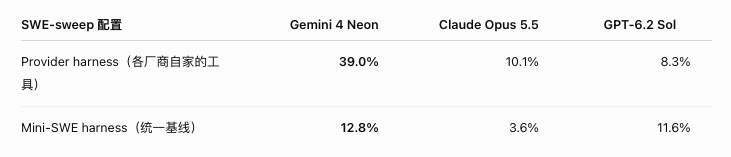
Antigravity’s harness and Gemini were jointly trained. Google also said Neon was optimized for long coding sessions, including fewer unnecessary file reads and improved context management. Antigravity can run multiple sub-agents in separate Git worktrees and verify their changes. How much each change contributed to the SWE-sweep result, and whether it transfers to other repositories, remains unverified.
Neon can divide coding work with Hydrogen, taking on planning and harder problems while assigning routine work to the lighter model. It can also use the /swarm feature introduced with Carbon to coordinate Hydrogen sub-agents in parallel. Google had not disclosed a per-task cost for that arrangement.
At launch, developers could access Neon through the Gemini API and Google AI Studio, while enterprise users could use Gemini for Business. Google AI Pro and Ultra subscribers could also use it in the Gemini app and Antigravity.
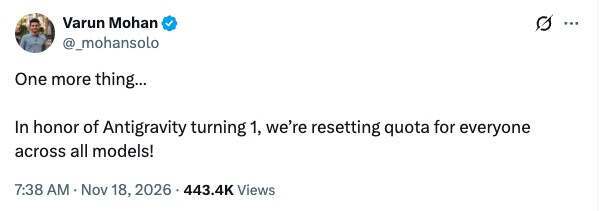
Separately, Antigravity marked its first anniversary with a reset of users’ consumed allowances across all models on the platform, including third-party models, according to Varun Mohan. The reset did not change plan limits: free users’ base allowances refresh weekly, while Pro and Ultra allowances refresh every five hours and remain subject to weekly caps.