On November 27, 2026, Robbyant released LingBot-Map 2.0, a model that builds a 3D map from a single RGB camera and corrects accumulated errors as a robot moves. It also open-sourced LingBot-Navi, a navigation model that uses the map to remember objects and their locations between tasks. A robot that has already explored a store, for example, can use what it saw on its first trip to plan a route when asked to find a different item.
Correcting the map, not just the recorded route
LingBot-Map 1.0, released in April 2026, could already reconstruct a scene in real time. The challenge on long routes was drift: small errors accumulated until the model’s estimate of its position no longer matched its surroundings. An external system can correct the recorded trajectory without correcting the spatial memory the model will use for its next decision.
Version 2.0 instead reuses local geometry it has already extracted from camera frames, realigns its higher-level memory of the route and writes the correction back into its cache. It does not need to process the images again or rely on an external module to recognize previously visited places and adjust the route.
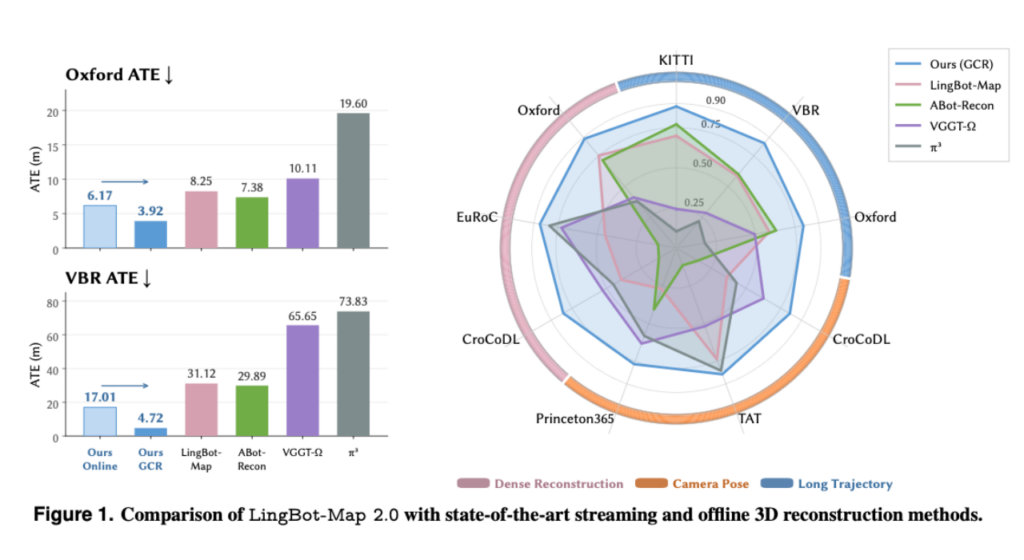
On the VBR urban trajectory test, which included routes up to 5.2 kilometers and nearly 19,000 frames, Robbyant reported a trajectory error of 4.72 meters, down from 31.12 meters with version 1.0. The best external correction method in the comparison recorded 9.98 meters. Across seven public datasets and nine evaluation settings, the team said the new model’s online mode outperformed other streaming methods on nearly all metrics. It reported an inference speed of 27.51 frames per second on a single RTX 5090.
Navigating from memory
LingBot-Navi accepts natural-language instructions, looks up a target in its 3D memory and plans a route to a stopping point nearby. Users can add details to distinguish similar objects. If the robot has not yet seen enough to locate the target, the model uses known spatial clues to guide further exploration. Robbyant says the model can run on the robot itself, keeping scene images and user instructions local.
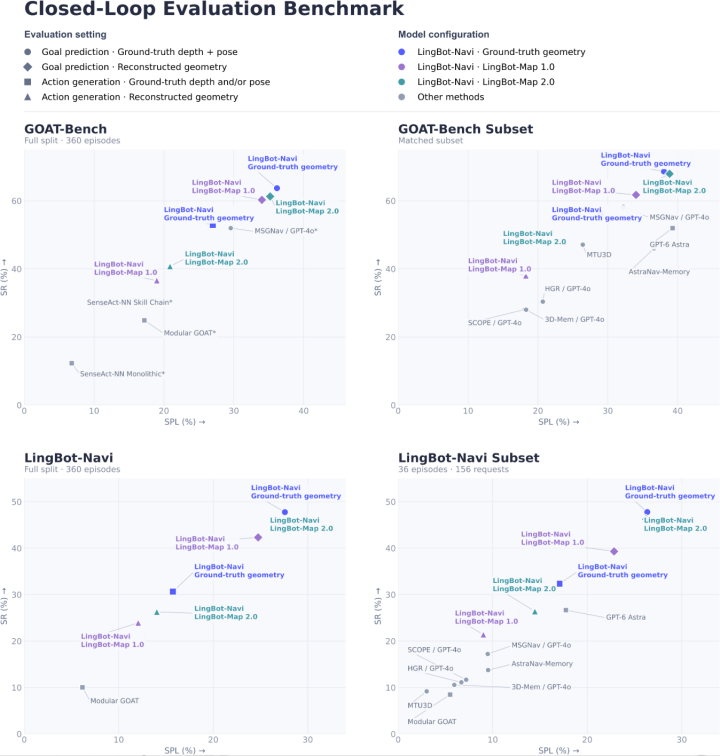
The team evaluated navigation in closed-loop simulation, using the public GOAT-Bench benchmark and an in-house dataset reconstructed from 36 real locations. On a GOAT-Bench subset, when Navi selected the target but the simulator handled movement, its success rate was 68.60%, or 10.36 percentage points above the best of six comparison methods.
The harder test required Navi to plan the route and direct movement itself. Its success rate was 56.09% on the GOAT-Bench subset and 32.36% on the in-house subset. Its path-length-weighted success scores, which reward successful arrivals with fewer detours, were 38.04% and 26.35%, respectively.
To isolate the effect of map quality, the team kept Navi’s model weights unchanged and switched the mapping model from version 1.0 to 2.0. Across the two full evaluation sets, navigation success rose by 4.15 percentage points on GOAT-Bench and 2.35 points on the in-house set. In those simulations, a more accurate map helped the same navigation model complete more tasks without retraining.
The release includes technical reports and code for both models, weights for LingBot-Map 2.0’s Pure Streaming version and for LingBot-Navi, and a dataset for successive navigation tasks collected from 511 real scenes, with accompanying evaluation cases.