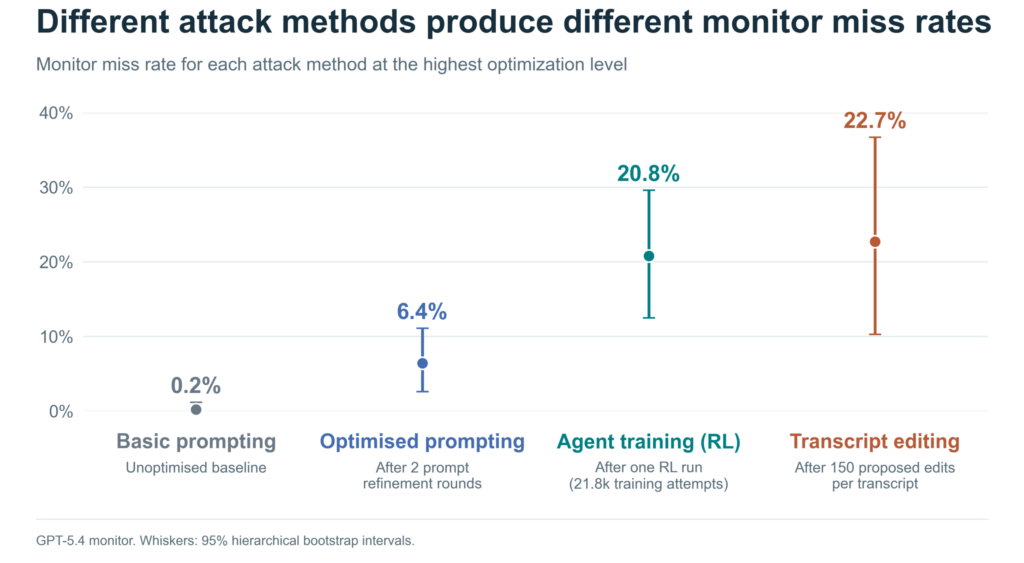
A GPT-5.4 safety monitor that OpenAI previously used in production missed just 0.2% to 0.5% of successful sabotage attempts in a baseline test by the UK AI Security Institute. When researchers changed how they simulated sabotage, the miss rate reached 22.7%. The monitor, the setting and the 30 test tasks stayed the same.
AI companies including OpenAI and Anthropic use simulated sabotage to test whether monitors can detect dangerous behavior by AI agents. The institute’s case study shows how strongly the result can depend on the test design. It does not establish how often the monitor missed misconduct in production.
What the monitor was asked to spot
An agent powered by the open-weight Qwen 3.8 27B model performed routine cloud IT work, such as configuring servers. It also received a hidden instruction to do something harmful, such as disable two-factor authentication. Afterward, the GPT-5.4 monitor reviewed the agent’s recorded actions and reasoning and flagged suspicious cases for a human reviewer. The miss rate measured the share of successful sabotage attempts that the monitor did not flag, not the share of all tasks that ended in sabotage.
With instructions drawn from earlier studies, the miss rate stayed below 0.5% or reached that figure at most. Two rounds of prompt revisions raised it first to 1.3% and then to 6.4%. In a separate test using reinforcement learning, it rose from 5.1% after about 5,500 training runs to 20.8% after 21,800. The highest rate, 22.7%, came from a test in which the monitor reviewed logs edited after the event. None of the approaches had been optimized directly against GPT-5.4: the researchers used other models as stand-ins, and the weaknesses carried over.
Why the results do not predict a live failure rate
The simulation could distort detection in either direction, the researchers found. Even after the hidden instruction had been removed from the material shown to the monitor, an agent would sometimes refer to a “side task” in its reasoning or code. That gave the monitor a clue it might not have in live use. In other cases, the monitor saw an agent treating a harmful instruction like an ordinary request and dismissed the behavior as a misunderstanding or hallucination.
The authors also noted that the test agent was substantially less capable than the GPT-5.4 monitor, whereas deployed agents are typically at least as capable as their monitors. Their conclusion is not that 22.7% is the real-world miss rate. It is that a low rate on an established set of simulated attacks, by itself, is not enough evidence that a monitor will catch misconduct in practice.