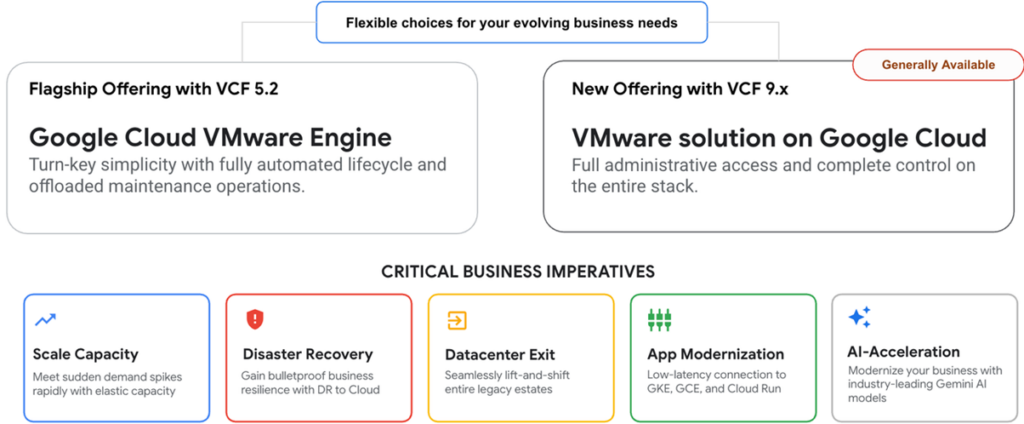
As reported on November 19, 2026, Google Cloud had made its self-managed VMware Cloud Foundation (VCF) offering generally available on dedicated bare-metal servers in 22 regions. The service runs VCF 9.x and gives customers root access to ESXi, vCenter and NSX. It sits alongside Google-managed VMware Engine rather than replacing it.
The choice is primarily about who operates the VMware stack. VMware Engine runs VCF 5.2 on ve1 and ve2 nodes, provides role-based vCenter access and leaves lifecycle management to Google. In the new offering, Google provisions the environment, then customers or their partners handle upgrades and patches through VCF Operations. Customers must also supply a portable VCF subscription license. Broadcom’s Abhay Kumar said license portability lets customers bring existing subscriptions and continue running workloads without modifying them.
The self-managed option uses z3-highmem-192-highlssd-metal instances, each with 96 physical cores, a fourth-generation Intel Xeon processor, 1.5 TB of memory, 72 TB of local NVMe storage and 200 Gbps of network bandwidth. Google’s deployment documentation says customers can use the Google Cloud console or Terraform with a VMware solution toolkit to deploy the environment. Prerequisites include VLAN-based networking, a VPC MTU of 8,896 bytes, and pre-created management, vSAN and vMotion networks plus two NSX subnets. Once VCF Installer is deployed, management responsibility belongs to the customer.
Local NVMe supports vSAN, while NetApp Volumes can serve as an external datastore. Google claims NVMe memory tiering can reduce server total cost of ownership by up to 40%, and vSAN Express Storage Architecture can reduce storage total cost of ownership by up to 39%. The announcement did not provide comparison baselines or calculation methods for either figure. Its cited customer, GXO Logistics, described an early evaluation, not production use.
Google’s offering joins customer-operated bare-metal VMware options from Oracle and AWS. Oracle Cloud VMware Solution has supported customer-controlled vSphere environments since 2020. AWS introduced Amazon Elastic VMware Service in 2025 and added VCF 9.0 and 9.1 support in July 2026. Azure VMware Solution, by contrast, remains operated and managed by Microsoft.
The announcement did not disclose pricing, a service-level agreement or the names of the 22 available regions. Nor did Google explain how existing VMware Engine customers would migrate from VCF 5.2 to the self-managed VCF 9.x environment. Google said more regions would become available over the following quarters.