DiffuSpace published a technical report and released supervised fine-tuning code for its Clover-35B-A3B-Preview diffusion language model on November 19, 2026. In an interview reported that day, co-founder and chief scientist Gong Shansan described a central challenge: generating tokens faster does not necessarily mean an AI agent finishes a task faster.
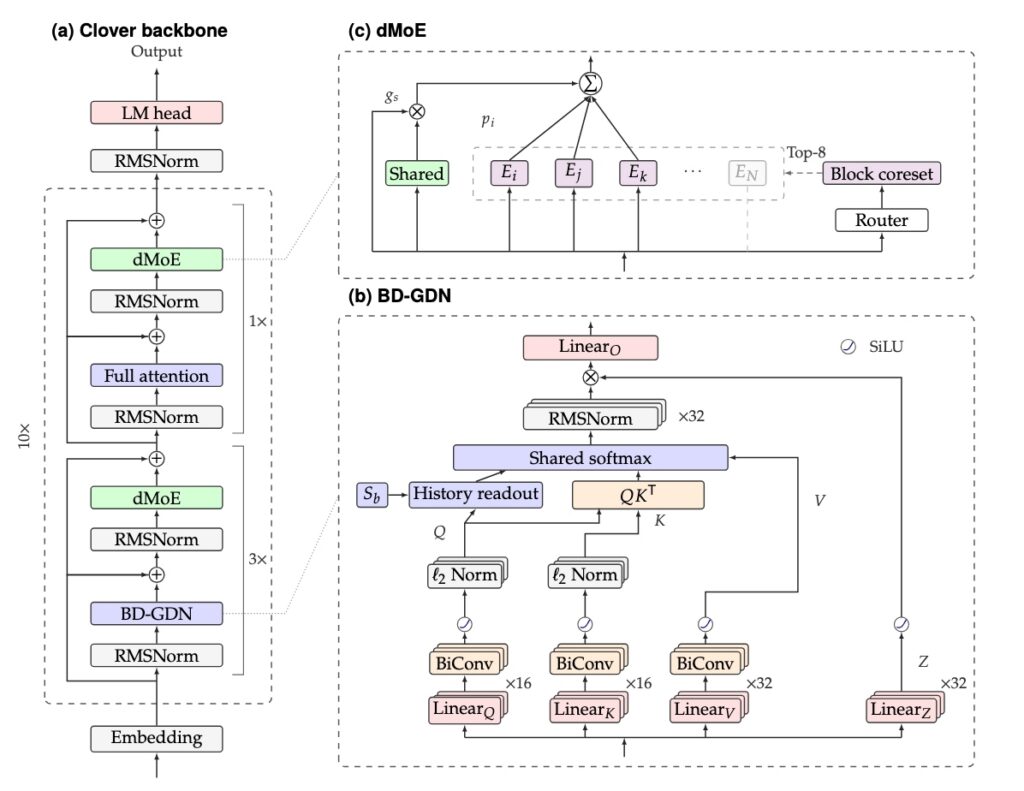
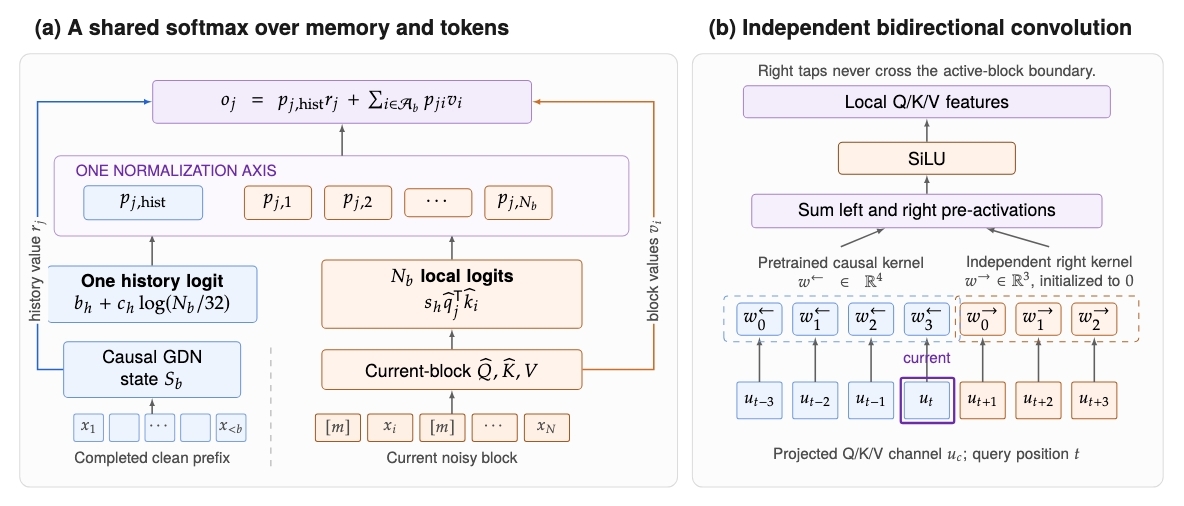
Clover has 35 billion total parameters, with about 3 billion active at a time. Unlike a conventional autoregressive model, which generates text from left to right, it generates multiple tokens in parallel and can revise them within a block. Completed blocks can be reused through a KV cache, reducing repeated computation over earlier context. DiffuSpace says its modified BD-GDN architecture also lets tokens within the current block use information from both directions.
In DiffuSpace’s technical report, Clover led the listed comparison models on seven agent benchmarks under a common evaluation protocol. Its reported scores include 73.6 on SWE-bench Verified, 51.7 on Terminal-Bench 2.1 and 65.3 on τ³ Overall. In some test configurations, the company measured token-generation speeds five to ten times those of similarly sized autoregressive models. These are reported benchmark results, not evidence that every agent workflow runs five to ten times faster.
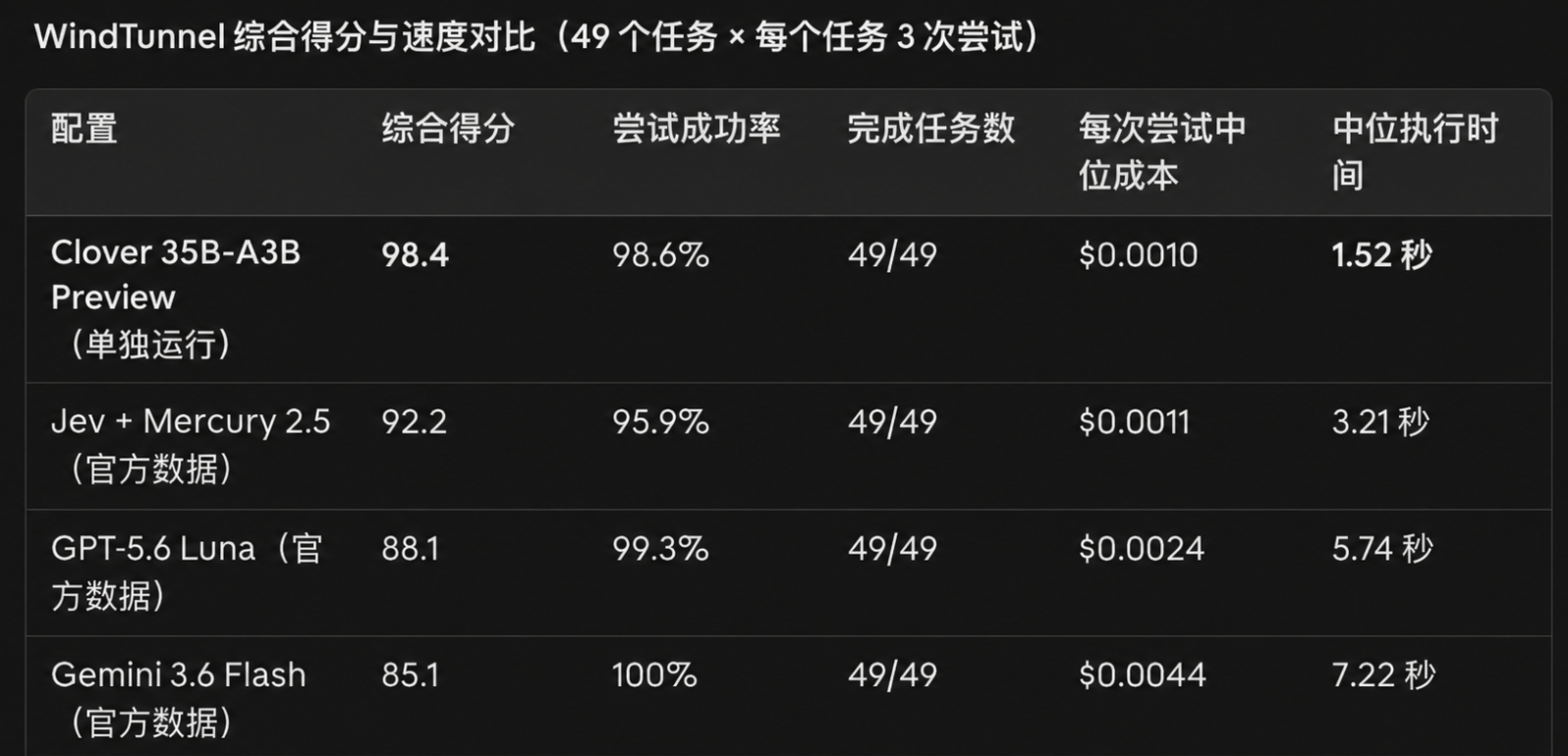
The report also describes two task-level comparisons. Clover completed a browser-based project-creation and invitation task in 13 steps and 169.9 seconds, versus 21 steps and 392.3 seconds for Qwen3.6 Flash. Across 49 WindTunnel tasks, Clover’s median execution time was 1.52 seconds, compared with 3.21 seconds for a Jev and Mercury 2.5 combination. Such results depend on more than the model: tool calls, execution frameworks, feedback and error correction all affect completion time. Gong said the team had not yet conducted a rigorous, systematic comparison of end-to-end task duration; her estimate that model-speed gains might translate roughly one-for-one into task efficiency was based on current usage experience.
DiffuSpace also reported results for a separate joint-decision model designed to answer related questions together rather than independently. On an internal validation set of 500 groups containing 2,420 related questions, joint prediction achieved 93.88% accuracy per question and answered every question correctly in 77.0% of groups. Independent prediction with the same model scored 90.37% and 65.4%, respectively. The company presents this as a potential use of bidirectional generation over short outputs; Clover’s longer generation still proceeds block by block, and Gong said full-sequence global planning has not been achieved.
Clover builds on capabilities learned during pretraining by the autoregressive Qwen3.6-35B-A3B before diffusion adaptation. DiffuSpace has released model weights and related code, including its supervised fine-tuning code, and says the model supports SGLang and llama.cpp. The company is also developing an agent execution framework suited to parallel generation.
Gong said diffusion models could replace similarly sized autoregressive models in some specific applications within one to two years—not that they would displace leading frontier models across the board. She identified scaling, multimodal research and the still-developing inference infrastructure as priorities and challenges. For users and developers, the unresolved question is whether Clover’s generation speed can consistently improve complete tasks without sacrificing quality.