In an interview published on November 16, 2026, Microsoft CEO Satya Nadella said advances in Anthropic’s coding models had challenged the editor-centered approach to software development. He also addressed Microsoft’s voluntary exit plan, announced on October 26. The interview was covered in a November 18, 2026 report.
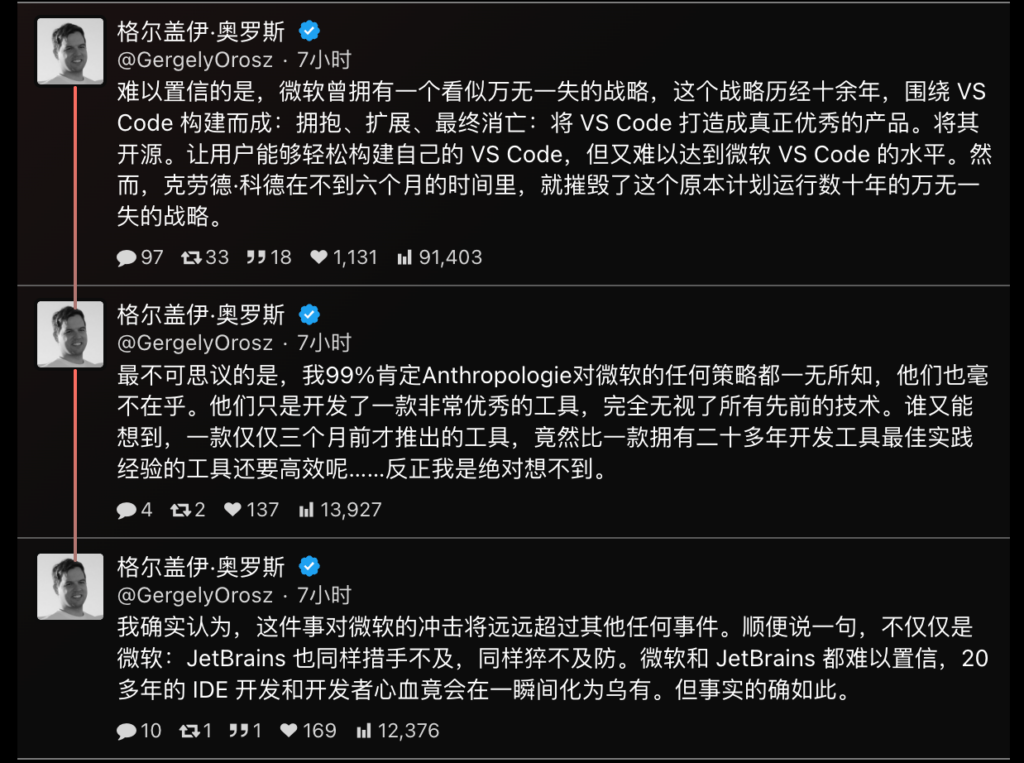
Speaking with The Pragmatic Engineer host Gergely Orosz, Nadella said Anthropic’s model improvements made a command-line interface practical for handing an AI system an entire coding task, rather than using it mainly to complete code inside an IDE. Orosz described developers moving away from IDEs over roughly six months following Claude Code’s rise in 2025. Nadella acknowledged the shift but said it might not be permanent: new ways of embedding AI capabilities in software could also revive the IDE.
Nadella described an emerging “software factory” in which engineers spend more time specifying work, assigning bounded tasks to agents and verifying the results. When generated code is inexpensive, he argued, validation becomes harder and more important. That includes turning failures into tests and using production logs to identify problems and check fixes. He characterized this as a change in how engineers work with code, not the end of software engineering.
Orosz asked whether the voluntary exit plan was a prelude to further layoffs as AI makes teams more productive. Nadella did not make that prediction. He said future opportunities, team sizes and workflows would differ, and that the plan was intended to give employees more choice as Microsoft reorganizes. He also said he could not promise that every part of the company would change at the same pace—or that everything would remain as it was. On slower hiring of junior engineers, he cautioned against treating a short-term pattern as a lasting trend before companies have established new workflows and staffing needs.
The interview also covered how enterprises should build AI systems. Nadella argued for keeping models, context, memory and agent tooling separable so companies can replace a model without losing control of their accumulated knowledge. On security, he urged companies to separate an agent’s capabilities from its authority to act, and to use runtime monitoring, audit logs and safeguards. These were his architectural recommendations, not a claim that such protections are already universal.