In a report published on November 17, 2026, InfoQ described openEuler’s November 13 announcement of an operating system approach for “Agentic Infra” and the release of openEuler 24.03 LTS SP5. The project said the release strengthens infrastructure for AI agents in areas including sandboxes, KV Cache, memory systems and security.
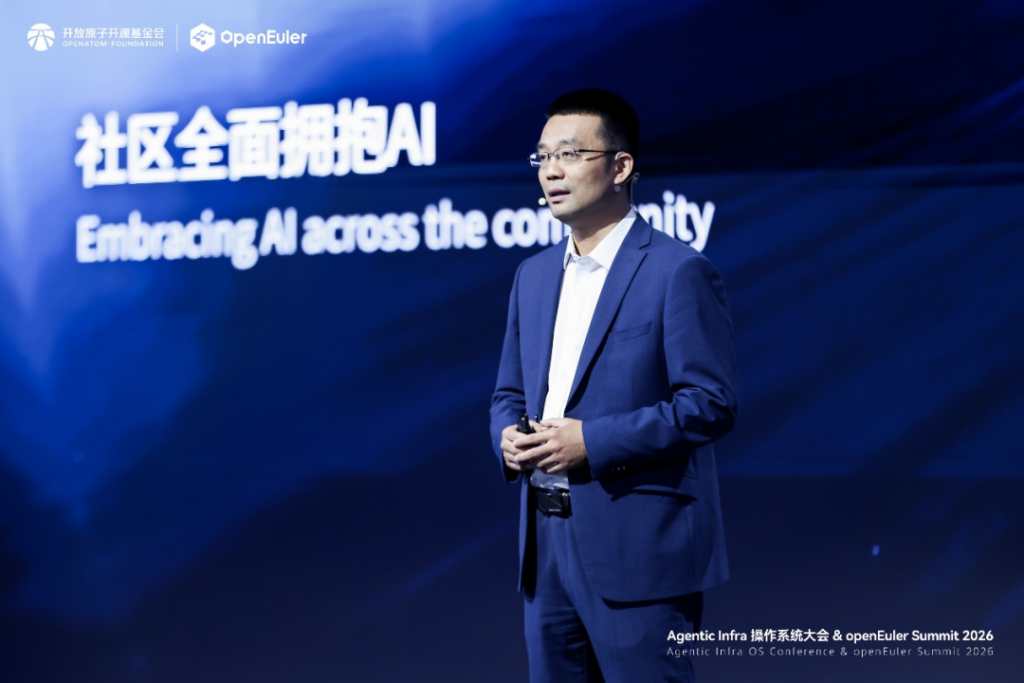
At the November 13 event in Beijing, OpenAtom openEuler committee chair Xiong Wei argued that the rise of AI agents does not require operating systems to be rebuilt from scratch. In his view, the operating system’s existing responsibilities—including resource management, scheduling and isolation—remain essential, but must adapt to workloads in which agents can rapidly call tools and launch multiple short-lived tasks.
Xiong highlighted sandboxes as one example. He said conventional virtual machines provide isolation, but their startup time and overhead may be poorly suited to frequent, short-lived agent tasks. The aim, he explained, is a lighter execution environment that retains necessary security mechanisms. He also identified efficient, lower-cost model inference and safer agent execution as priorities for the underlying system. These are design goals, not reported performance results for SP5.
The announcement builds on openEuler’s 2025 work on operating systems for supernodes, which coordinate resources across nodes. Xiong said compatibility with existing software interfaces matters, but applications may need new interfaces to take full advantage of the hardware. As an example of work already deployed, he said openEuler and JD.com used supernode hardware, an operating system and KV Cache technology at scale during the 2026 Singles’ Day period, reducing latency for the relevant business workload by approximately 15%. The figure was presented by Xiong; the report did not provide an independent benchmark.
The event also included the Pakistan Higher Education Commission’s release of HECOS 1.0, described as the first overseas local operating system based on openEuler. openEuler announced technical exchanges with Ubuntu in areas including supernodes and an Agentic Infra ecosystem initiative with partners. Separately, the community set goals for the end of 2026: AI-assisted handling of 80% of CVEs and full integration of its community-service agents. Those figures describe plans, not completed outcomes.